How SEO works for product-led and sales-led SaaS: what stays the same, which searches and pages matter in each, and how to measure SEO by activation or pipeline.
Anita Valentinova
Published
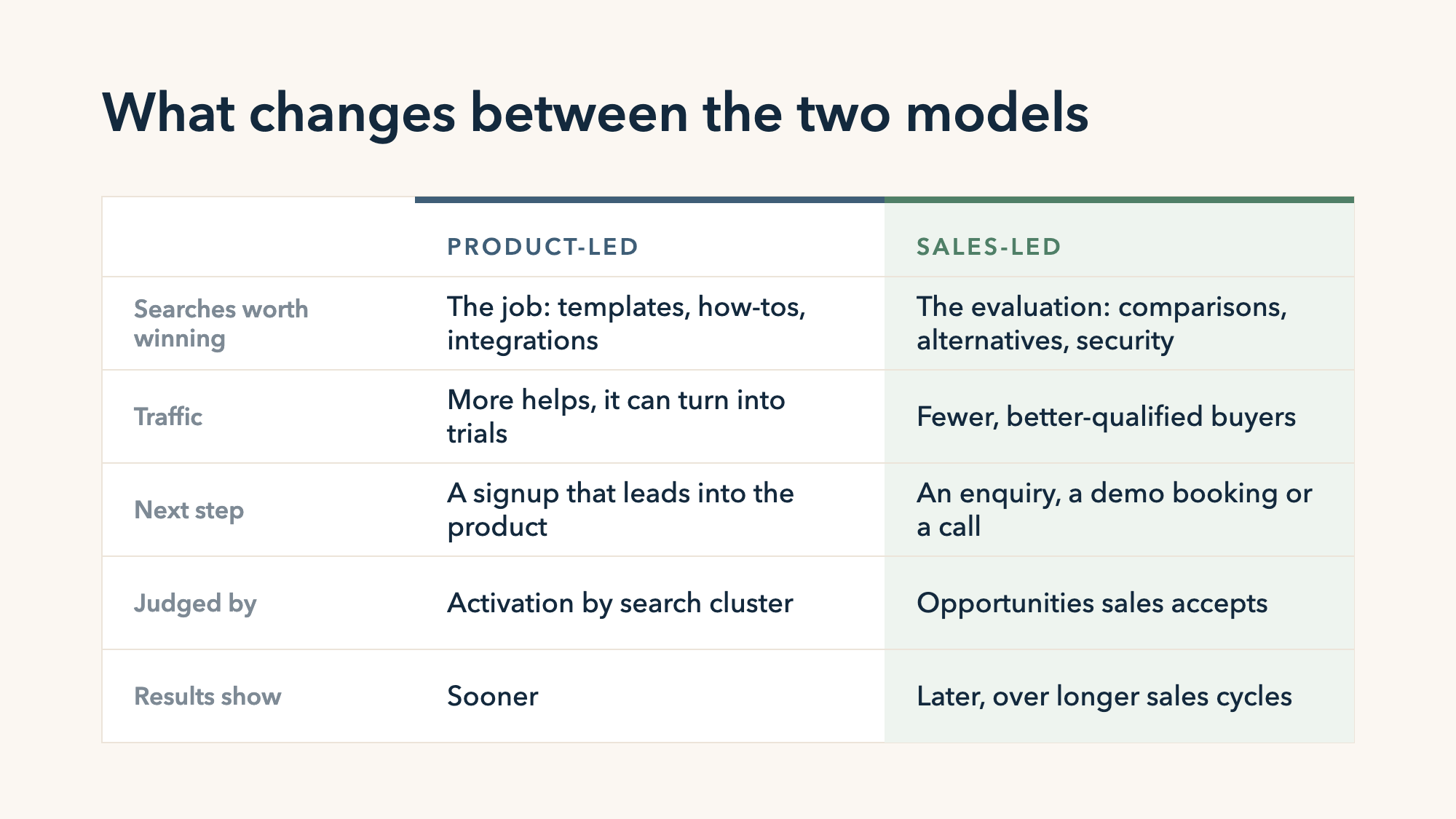
SEO for product-led and sales-led SaaS starts in the same place: choosing the search demand worth winning and building pages that match it. What changes is what the page hands the visitor and how you judge it. Product-led SEO welcomes volume and is measured by activation. Sales-led SEO prequalifies a buying group and is measured by the opportunities sales accepts.
When a product-led SaaS team asks me about SEO, they often bring a sales-led plan with them. There are comparison pages, a demo request on every page and a content calendar built around a buyer who will talk to sales. The product, meanwhile, is designed for someone who wants to sign up and try it today.
The opposite happens too. A sales-led company reads about product-led growth, publishes a set of templates and wonders why none of the traffic turns into conversations with the companies it actually sells to.
Both teams are right that SEO matters. In my experience, the search fundamentals do not change much between the two models. What changes is what the page has to hand the visitor, and how you decide whether search is working.
Whether the product is bought through a trial or through a sales conversation, SEO starts with the same decisions. Who is the product for, which of their problems does it genuinely win on, and which of those problems do people search for? From there, you choose the demand worth pursuing and build the pages that meet it.
That work is covered in detail in my SaaS SEO strategy guide. The short version is that relevant search demand is not automatically valuable search demand, and that the pages closest to a buying decision usually deserve attention before anything informational.
Technical health, internal links and clear page structure matter in both models too. A page that search engines cannot read or that nothing links to will struggle, whatever happens after the click.
In a product-led model, the person searching is often the person who will use the product. They are trying to get a job done, and they may sign up the same day if the page shows them how.
That changes the searches worth winning. Product-led products often find valuable demand in searches about the job itself: a template, a how-to, a specific integration, a problem the product solves in a few minutes. Consider a self-serve social scheduling tool. Someone searching for a content calendar template is doing the work the product exists for, even if they have never heard of the category.
In a product-led model, search is often the lead channel itself. Traffic from people searching for the problems the product solves is worth having in volume, because a visit can turn into a trial without anyone on the team spending time on it. In my view, a wide set of pages that answer those problems well also gives AI answers more to draw on, which can bring more people to the signup.
It also changes what the page has to do.
Show the job, not the feature list
The page should show how the product helps with the specific task the person searched for, ideally with a screenshot or a short walkthrough of that task.
Make the signup the natural next step
A product-led page usually asks for a signup or a free start, not a demo. The ask should feel like a continuation of the task, such as starting from the template they were looking at.
Hand over to the right first session
This is where many product-led teams lose the value of their SEO. Someone who signed up from a page about scheduling a week of content should land in an onboarding step that helps them do that. If they land in a generic empty dashboard, the signup often goes quiet.
The measure follows from that. Signups from search are an entry point. What tells you whether SEO is working is whether accounts from each search cluster reach first value: a connected channel, a first scheduled post, whatever the product's activation event is. A cluster with plenty of signups and little activation is a problem to investigate, not a success to report.
In a sales-led model, the person searching is often one member of a group that will make the decision together. A project director, an IT lead and a finance manager may all research the same purchase, and each needs something different from the page.
The searches worth winning tend to sit closer to an evaluation. Comparisons with named competitors, alternatives to a tool they want to replace, questions about security, integrations, implementation and pricing logic. Consider construction management software. A search comparing two platforms for subcontractor coordination is usually made by someone with a shortlist and a deadline.
Top-of-funnel search traffic behaves differently here. Most informational searches are not transactional for a sales-led product, and every conversation costs a salesperson's time. A smaller pipeline of well-qualified buyers is usually worth more than a large one that sales has to filter.
The page has a different job.
Answer the questions each member of the buying group brings
The economic buyer wants to understand cost and value. The technical evaluator wants security and implementation detail. The daily user wants to see the product working. A page that satisfies one of them and leaves the others to ask sales has not made the decision easier.
Carry proof the buyer can share
In B2B, the visitor often has to justify the next step internally. Proof that a colleague can read and trust, such as a relevant customer example or clear security information, does a lot of work.
Choose the route into sales with care
Sales-led funnels use different routes, and each carries a different level of friction. An enquiry form followed by booking a demo asks the most. Direct booking into a calendar asks less. A phone call suits some buyers and not others. Match the route to how ready the visitor is likely to be.
Prequalify before the call
The page and the form should help the wrong buyers rule themselves out and the right ones arrive prepared, so the sales team does not spend its time on calls that were never going to go anywhere.
Sales-led products benefit from an indexable resource the lead can read before joining the call. It answers the objections buyers usually raise, explains how the product fits their situation and sets expectations for the conversation. The lead arrives better prepared, and the call can start further along.
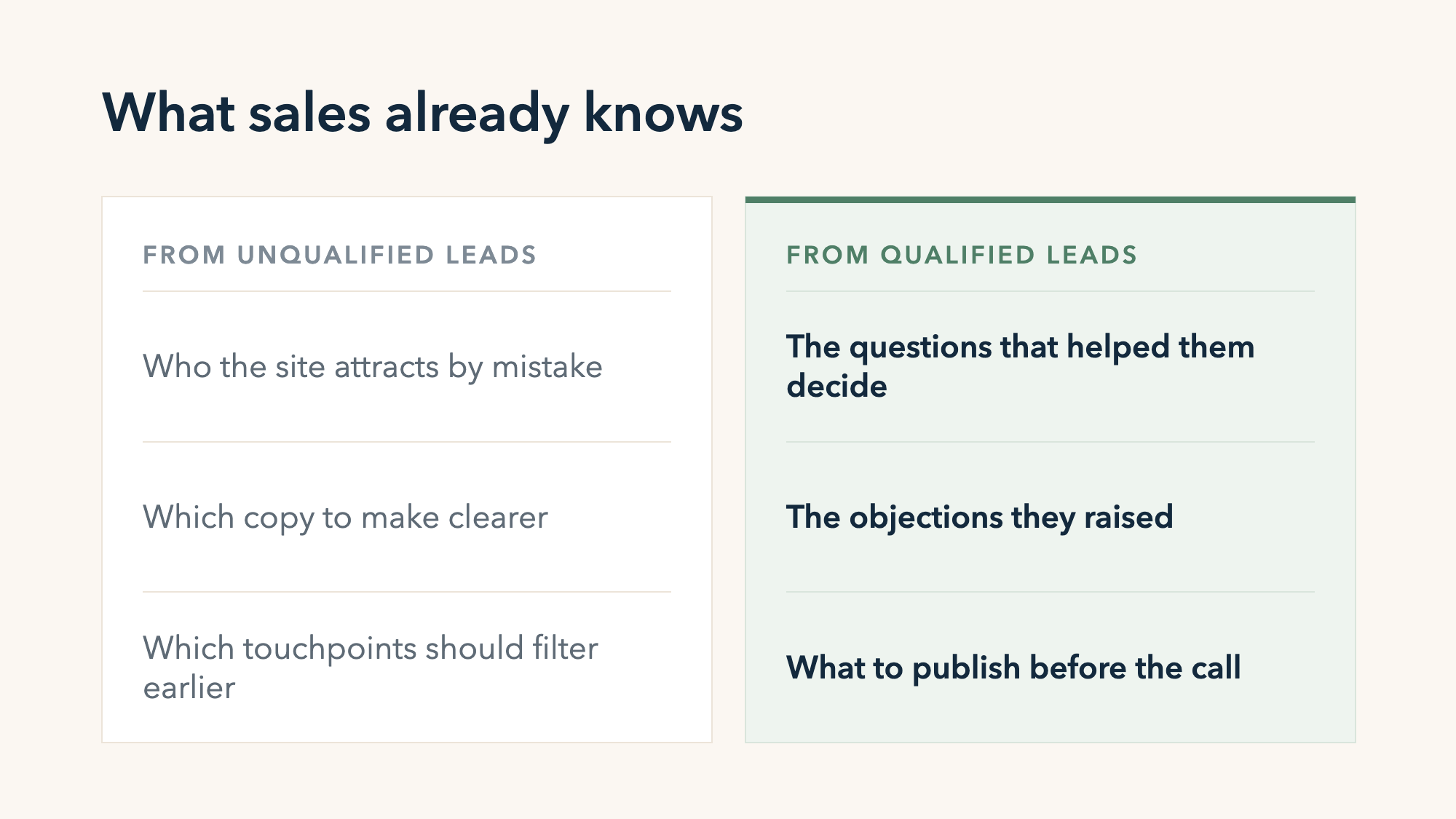
Sales already knows what that content should say. Talk to the team and build a body of notes from both kinds of lead. Unqualified leads show you who the website is attracting by mistake, so you can filter them out earlier with clearer copy and the right touchpoints. Qualified leads show you the questions, objections and details that helped them decide, so you can put that information on the website.
There is a second reason to publish it. Prequalification increasingly happens before the visitor reaches your site, in AI search and in conversations with assistants. If content that answers your buyers' objections exists and is easy to read, it can be part of that research. If it does not, the buyer forms a view from whatever else is available.
The measure is also different. A demo request is not the outcome. What tells you whether SEO is working is whether the requests from each cluster become opportunities sales accepts, and later, deals. Results from SEO or AI search take longer to show up in the pipeline, because sales cycles are longer. Attribution across a long buying cycle is never perfect either. A consistent view of which search clusters produce qualified conversations is a realistic standard.
Many B2B products have a hybrid funnel. A developer or an operator tries the product, and a buyer with budget talks to sales later. Here the work is routing. The page should let the person who wants to try the product start, and let the person who needs a conversation find it, without forcing either into the other path.
I see the same mistake in both directions. Product-led pages that hide the demo option lose larger accounts. Sales-led pages that force a demo lose evaluators who wanted to try first. How the work is planned differs too, which I cover in the section on sales-led versus product-led SaaS in the B2B SaaS SEO roadmap.
Start by being honest about how your product is actually bought today, not how you would like it to be bought. Be honest about it because the content you publish is what makes you visible in AI search. If it attracts buyers and then confuses them, AI search has less reason to recommend you, and the pipeline does not follow. Look at recent customers and ask how they started: a signup, a demo request, a referral, a sales outreach.
Then check your search pages against that motion.
Yes, the two models overlap, and many companies run both. The point is not to pick one label. It is to make sure each search page leads to the next step your product can actually deliver, and that you judge it by what happens after that step.
The search fundamentals are the same, but the page has to lead into the product. Product-led SEO often targets searches about the job itself, such as templates, how-tos or integrations, offers a signup as the next step and is measured by whether accounts from each search cluster reach activation.
SEO helps a buying group find, evaluate and prequalify the product before they talk to sales. It wins searches close to an evaluation, answers buyers' objections in content they can read before the call, and is judged by whether the resulting requests become opportunities that sales accepts.
It can, if larger accounts or technical buyers need a conversation. The main path should still let people start using the product. Offer the demo as a secondary route for those who need it, so it does not block the people who want to try first.
By what happens after the signup. Track signups by search cluster, then check whether those accounts reach the product's activation event. A cluster with many signups and little activation needs investigating, because the page or the first session may be promising something different.
Because the outcome is a qualified opportunity, not a signup, and sales cycles are longer. Search and AI answers may shape a buyer's shortlist months before they book a call. Judge sales-led SEO by which search clusters produce qualified conversations over time, rather than by quick changes in form fills.
Yes, and many B2B products need to. The work is routing: letting people who want to try start straight away, and making it easy for people who need a conversation to find one. Each commercial page should make both paths visible without forcing visitors into the wrong one.
Do not borrow an SEO plan built for a different buying motion. Match your search pages to how your product is actually bought, and judge them by what happens after the click.
Want to review your search funnel for more pipeline, covering both strategy and conversion? Book a website review call. I will look at one priority path with you, from the search to the signup or demo request, and tell you where I would start.
 GrowthLens