Search strategy

SaaS SEO Strategy: What to Build, Why, and What Happens After the Click

Illustration of stylised document cards standing in blue arches, over the article title, its date and its byline

How to choose commercially valuable search opportunities, build the right pages, and connect SEO to qualified pipeline.

Anita V. · Co-Founder of GrowthLens

Product and Growth for Tech

LinkedInPublished 19 min read

My experience shows that many understand SEO, even for technology companies, as a keyword list with a publishing schedule attached to it. It is a set of decisions which guide or change a search strategy, be it classic search, GEO, AEO, it is who the product is for, which of their problems it genuinely wins on, which of those problems people search for (pain points), what their objections are, which pages meet that demand, what those pages say, and what happens to the person after they click. The latter holds true for every SEO strategy initiative or reset, because the click turns the organic visibility into a pipeline. Research is what makes those decisions answerable, which is why it comes before keywords and a long way before content production.

That order gets reversed constantly. Teams commission content, switch on Google Ads or start a redesign before anyone has written down the ICP, the buying group, the use cases the product is commercially strongest at, or the words customers use for the problem. It is rarely carelessness. The question has usually never had to be answered in one place before, and search is the first activity that forces it.

Relevant search demand is not automatically valuable search demand.

A feature keyword can be relevant, have volume, and still be a poor thing to build for. The product may not be a strong fit for the problem sitting underneath the search. The feature page may not be able to carry the outcome, the proof and the next step that buyer needs. The queries may be held by review sites and competitors with a decade of authority behind them. Or the traffic may have no credible route to a qualified conversation, a trial that activates, or revenue. Any one of those makes the keyword relevant and the opportunity poor.

Two kinds of evidence inform these decisions. The first is what search is already producing for you, read through Search Console, analytics, the CRM, product analytics where there is a trial, and what customer-facing teams hear. The second is customer and market research: the ICP and buying group, the pains and the language around them, the positioning that holds, the competitors and results a buyer meets, and an honest read on what you can rank for and convert. Neither is enough alone. Performance data tells you what is happening without telling you why, and research tells you why without telling you where you stand.

Research is the layer that connects the decisions:

ICP and customer insight, then the pains and positioning that are commercially viable, then the search demand that matches them, then the website architecture and pages, then the message and next step, and finally qualified pipeline or activation.

Read that as a chain of constraints rather than a sequence of tasks. What you learn about the buying group changes which pains are worth owning. What you learn about the pains changes which demand is worth pursuing. What you learn about the competition for that demand changes which pages can win it, and what sales tells you about the resulting conversations sends you back to the beginning. The research does not produce a checklist to work through. It changes the decisions you would otherwise have made by default.

My background is in B2B technology and SaaS websites, search architecture, conversion journeys and customer research, which tends to make me look at search as one part of a commercial system rather than as a channel with its own scoreboard. What follows is what I have learned from that work, including the places where the honest answer is that it depends.

Start with the current commercial picture

An established SaaS company should find out what search is already producing before deciding what to build next. The data exists, it costs nothing to read, and it usually contradicts at least one thing everybody believes about the programme.

Read five sources together rather than one at a time:

  • Search Console for impressions, clicks, queries, landing pages and how visible you are by demand cluster.
  • Analytics for what visitors do after they land, including whether they engage the call to action and convert.
  • The CRM for demo requests, sales acceptance, opportunities created, win rate and the reasons deals were lost.
  • Product analytics, where the business is trial-led, for activation and whether accounts reach early value.
  • Sales, support and customer success for what buyers actually ask, object to and misunderstand.

Read together, they point at one of five findings, and each one implies different work:

  • The demand exists and you are barely visible for it. A coverage problem. The pages either do not exist or cannot compete, and the question is which of those it is before anything gets commissioned.
  • Impressions are healthy and nobody clicks. A relevance and presentation problem, usually a mismatch between what the query wants and what the result promises.
  • Clicks arrive and produce no demos or trials. The page is reaching people without helping them decide: wrong message, missing proof, or a next step they are not ready for.
  • Demos or trials arrive and sales declines them, or accounts never activate. The demand is reaching you and it is the wrong demand, or the path after the click breaks. Either way, more traffic makes it worse.
  • A small cluster is producing unusually good conversations. The most commonly missed finding, because the volume is too low to draw attention in a channel report. This is the one to expand.

The strategy comes from setting that internal evidence against ICP, customer, competitor and SERP research. On its own the performance data will tell you that a page underperforms without telling you whether the buyer it attracts was ever worth attracting. None of this is a technical SEO audit. It is a commercial diagnosis of the search-to-customer path you already have, which is what makes the result a strategy rather than an audit, a keyword list or a content calendar. None of those three decide which customers the business should be pursuing.
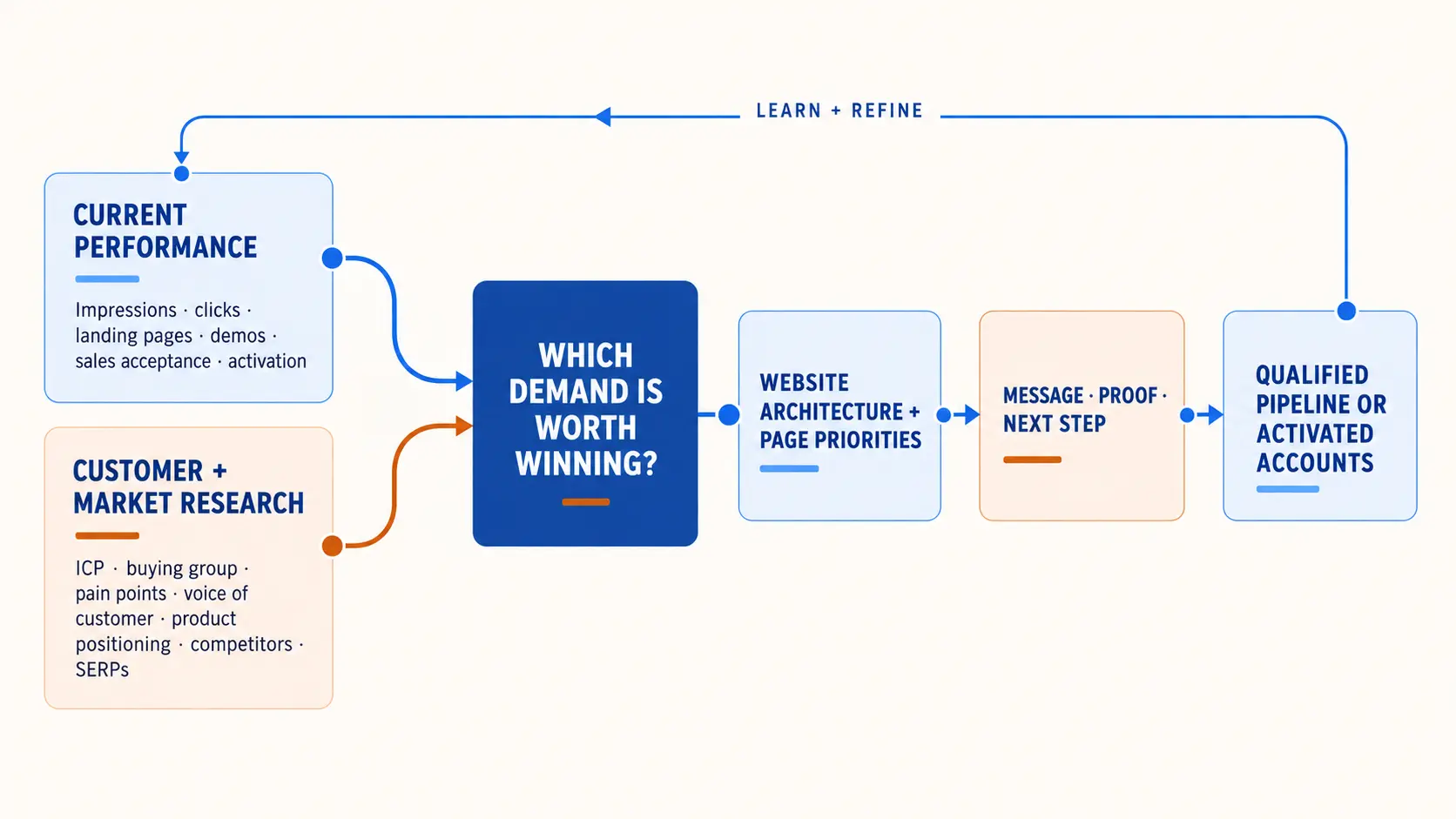
Two streams of evidence feeding one question. Current performance (impressions, clicks, landing pages, demos, sales acceptance, activation) and customer and market research (ICP, buying group, pain points, voice of customer, product positioning, competitors, SERPs) both lead into: which demand is worth winning? From there to website architecture and page priorities, then message, proof and next step, then qualified pipeline or activated accounts, with a learn and refine loop running back to current performance

Start with the ICP, buying problem and product position

Before a single keyword is exported, three things need to be written down: who you are for, what they are trying to fix, and where your product genuinely wins rather than merely competes. Everything downstream is a guess until those exist.

In intake conversations I often find that teams cannot yet describe their ICP clearly, separate the personas involved in a purchase, or say which problems the product is commercially strongest at solving. Campaigns and content production have usually started anyway. That is the most expensive kind of momentum, because it produces pages nobody can later defend.

The research that settles it is not a long document. It covers:

  • The ICP and the buying group. Not a company size band, but who signs, who evaluates, who uses the thing daily, and what each of them has to believe before a purchase happens.
  • Pains, desired outcomes and the language buyers use. What they were trying to fix, what better looked like, and the words they used before they found your category. Those words are frequently not the words your product team uses.
  • Product position and where you win. The use cases you beat the obvious alternatives on, and the ones where you are a reasonable second choice. A strategy built on the second list produces leads sales cannot close.
  • Sales insight, lost deals and support questions. The questions reps answer repeatedly, the reasons deals were lost, and the tickets that arrive in the first month are the cheapest research in the business, and they are already written down.
  • Customer research. A handful of interviews with recent customers will tell you more about the buying problem than any keyword tool can.
  • Competitive and SERP research. Which competitors buyers compare you with, what pages currently win the query, what evidence those pages use, and where the market leaves a useful gap. This tells you both what buyers expect and whether you have a realistic route to compete.

The strategy has to be agreed with product, sales and customer-facing teams, because search cannot decide which customers the business should pursue or which promises the product can keep.

Do this first and the keyword work becomes fast, because most of what a tool returns can be discarded on sight. Skip it, and the keyword list becomes the strategy by default, which is how a company ends up ranking for terms its product cannot serve.

Decide which search demand is commercially worth pursuing

Demand is worth pursuing when the searcher is close enough to a decision for the visit to matter, the product genuinely wins that use case, a customer from that demand is worth what the page costs to produce, and you can realistically compete with what already ranks. Volume is not on that list, though it is usually the only number available at the start.

Volume counts people rather than intent, and the two pull apart as a buyer approaches a decision. Broad category questions collect students, competitors and people whose budget cycle is years away. The queries close to a purchase attract a fraction of that audience, and a far higher proportion of it is actively evaluating.

Timing makes that gap wider in B2B than the raw numbers suggest. 6sense's 2025 B2B Buyer Experience Report surveyed roughly 4,000 buyers. On average, respondents first contacted a seller about 61% of the way through their purchase process, and the vendor that eventually won was on the buyer's day one shortlist 95% of the time. 6sense sells intent data and the research is self-reported, so treat the direction as instructive rather than the numbers as a benchmark. The point stands: most of the work of getting shortlisted happens in research nobody on your side observes.

Two judgements then decide whether a candidate opportunity survives.

Can you rank for it? That depends on your authority relative to whoever holds the result, the page type the query rewards, how contested the result is, and whether you hold the proof the page would need. A query owned by three review sites and a competitor with ten years of citations is a different project from one where the best result is a thin blog post from 2021.

Can you convert it? That depends on whether the page can match the searcher's message, carry proof they find credible, make an offer that fits where they are, and hand them a next step the business can actually service. A demo request from someone three months from a decision is a next step nobody wants.

Why does a relevant keyword produce poor leads?

Because relevance describes the topic, not the fit. A term can be entirely relevant to your product while the page, the message, the proof and the next step all fail to help the right buyer work out whether you suit them. The result is a report full of promising traffic and a sales team asking where these enquiries are coming from.

This is where the feature keyword problem usually shows up. The feature exists, the search exists, so the page gets built. But the buyer searching that term is trying to solve something the product handles only partially, and the page can describe the feature without being able to describe the outcome. The traffic arrives, the form stays quiet, and the cluster gets defended in reporting for another two quarters because the impressions look healthy.

In practice, useful prioritisation produces clusters rather than keywords. A cluster is a group of searches and questions from the same buying moment that one page can answer well. "Contract management" is a topic covering several moments. "Buyers comparing us against the incumbent they already pay for" is a cluster, specific enough to decide what the page has to do and what it has to lead to.

Turn demand into a website architecture, not a content calendar

Chosen demand becomes a structure of pages with a purpose each, not a list of titles with dates against them. The difference matters because a calendar can be delivered in full while the site remains impossible for a buyer to navigate towards a decision.

At Telerik, later Progress, I saw how much of the commercial work a B2B technology website has to do on its own. Demand was mapped deliberately to page type: high-value head terms to core commercial pages, persona and use-case demand to solution pages written for those situations, and longer-tail questions to webinars, whitepapers and other resources where they genuinely belonged. The aim was less about publishing volume than about making the site understandable to buyers at different stages of evaluation.

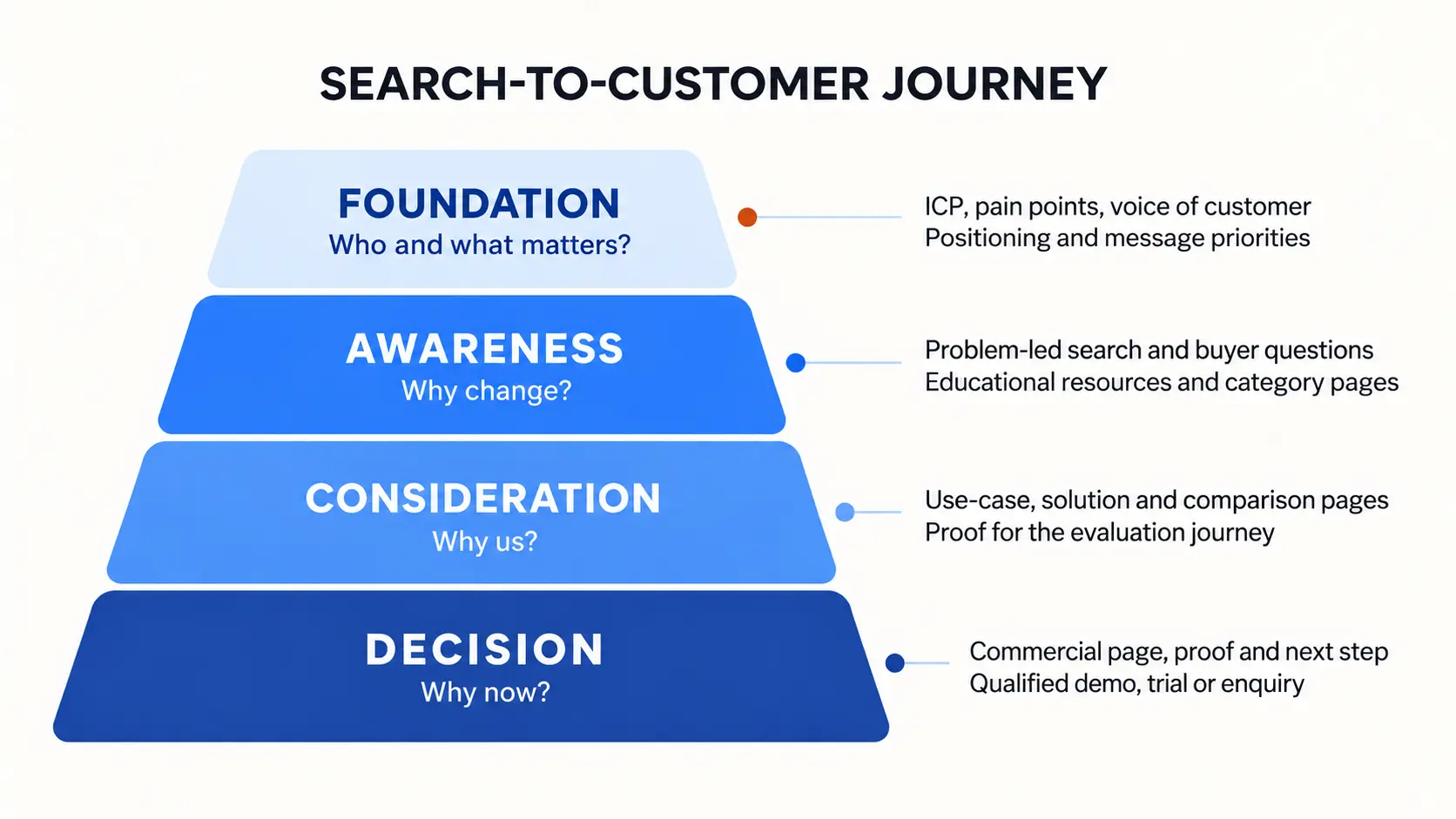
The search-to-customer journey as four stacked stages. Foundation, who and what matters: ICP, pain points, voice of customer, positioning and message priorities. Awareness, why change: problem-led search and buyer questions, educational resources and category pages. Consideration, why us: use-case, solution and comparison pages, proof for the evaluation journey. Decision, why now: commercial page, proof and next step, leading to a qualified demo, trial or enquiry
Demand mapped to page type by buying stage, from the foundation work through to the commercial page and its next step.

Core commercial and category pages carry the head demand. They have to be legible to someone who does not yet use your label for the category, which means checking what your customers called the problem before they found you. Everything else sits around those pages and points back to them.

One constraint is worth surfacing early, because it tends to arrive as a surprise in month four. A site organised around the product's internal structure will not comfortably host pages organised around buying problems. If the architecture has to change, that work belongs in the plan from the start, with the internal linking and page purpose decided before anyone writes.

Which pages should a B2B SaaS website prioritise first?

The pages closest to a decision your product demonstrably wins, in the language the buyer already uses. For most B2B SaaS companies, that means two or three commercial pages before anything informational: a category or solution page for the strongest use case, a page that helps buyers evaluate the category, and, where CRM evidence supports it, a comparison page for the competitor that repeatedly appears in deals.

Informational content earns its place after those exist, because it has somewhere to send people.

Choose the right page, message and next step for each buying moment

Every buying moment carries its own job, and the page that serves it has to match all three things: the page type the query rewards, the message that moment needs, and a next step the reader is ready to take. Getting the page type right and the next step wrong wastes the page.

Which comparison and alternatives pages are worth building?

The searcher's job is to decide between named options, or to replace a product they have already decided against. Someone searching your category plus a competitor's name is usually mid-evaluation with a shortlist. Someone searching for alternatives to a tool has made the harder decision already.

Build a comparison page that takes a position on which team each product suits, and an alternatives page that is honest about who you do not suit. Both need the CRM to justify them: check that the competitor appears in your deals often enough to be worth the page, and look for evidence of switching in win reports, community threads and what people say on review sites when they move.

Skip it when the competitor rarely appears in your pipeline, when the business will not publish a clear position on where the other product is stronger, or when what you would produce is a feature table with no point of view. Buyers read those as marketing and trust them accordingly.

The next step differs by page. A comparison page can lead to a demo, because the reader is choosing. An alternatives page usually has to answer the migration question first, since someone leaving a tool wants to know whether their data, workflows and integrations can come with them before a call is worth booking.

What should you do when review sites and "best" lists dominate the results?

Treat it as a signal about intent rather than a ranking problem. A page of roundups and review-site profiles usually means the searcher wants a shortlist from someone who is not selling to them, and that is a job your own website cannot do for them however good the page is.

Three responses work. Keep your presence accurate and current on the third-party pages that already rank, because your review profiles are doing that work whether or not anyone owns them. Build the page answering the question underneath the search, which is how to choose in this category: the criteria that matter, the trade-offs, and where different approaches win. Then build comparison pages for the products that appear on those shortlists, because that is where the searcher goes next.

What does not work is a "best software" listicle that ranks your own product first. It rarely earns the position, buyers recognise it immediately, and it costs the credibility of everything else on the site.

Where do templates, guides and webinars fit?

They fit when the asset supports a job your product solves. A Kanban template is informational and carries no purchase intent at all, yet it is commercially relevant for a work management product, because the person downloading it is doing the work the product is for. A webinar, whitepaper or practical guide serves the same purpose when the topic sits close to the problem you are hired to fix.

Skip it when the job it supports is not the job your product does, when there is no sensible route from the asset to a commercial page, or when it exists to hit a publishing target.

The next step matters more here than anywhere else. It is usually the use-case page for the job the reader is doing, not a demo request. Someone who came for a template is not evaluating vendors yet, and asking them to book a call is how a genuinely useful asset ends up with a conversion rate that makes people stop producing them.

When are persona and use-case pages the right answer?

When the searcher has told you their situation in the query. Project management software for IT project managers is a different search from project management software, and the person making it has handed you the role, the constraints and usually the vocabulary.

Build a page that uses their words for the problem and carries proof that speaks to their situation: customers who look like them, terminology they use, the constraints they work under. Industry pages belong here too, and are worth building only where there is something genuinely different to say.

Skip it when you lack proof specific to that segment, when sales does not actively sell into it, or when it is a use case you tend to lose on price. Those conversations cost more than the traffic is worth.

The next step is a demo or a trial, depending on the motion. For trial-led products, the page should connect to the part of onboarding that reaches value for that particular use case, because a signup from a specific situation that lands in a generic first-run experience usually goes quiet.

Treat the post-click journey as part of the SEO strategy

The click is the middle of the process, not the end of it. A search strategy that stops at the landing page is measuring its own activity, and the decisions that determine whether demand becomes revenue sit on the other side of that click.

Two things decide what happens next. The first is whether the page matches what the searcher came for, proves it to the people who have to be convinced, and offers a step they are ready to take. The second is whether the business can service that step well enough to keep the conversation alive.

The buying group complicates the first. The economic buyer wants pricing logic, the technical evaluator wants security and implementation detail, and the daily user wants to see the product working. A page that satisfies one of them and leaves the others to ask sales has moved the conversation forward without making it any easier.

What happens after a signup or a demo request?

For trial-led products, what matters is whether accounts from a given cluster reach the point where the product proves itself. The same query can produce excellent signup numbers and poor activation, depending entirely on what happens after the button. Signups that never activate are not a search result worth repeating, which makes onboarding part of the search question rather than someone else's problem.

For demo-led products, the equivalent test is sales acceptance. A demo request that sales declines is a cost, not a win. When comparison demos convert to accepted meetings at a better rate than category-level ones, that is evidence about which demand to pursue next, and it is available months before revenue data arrives.

Measure demand quality through pipeline, activation and sales feedback

Measure by demand cluster, through to accepted pipeline and activation, rather than by channel through to form fills. Reporting by channel tells you organic produced 40 demo requests. Reporting by cluster tells you the comparison pages produced twelve, of which nine were accepted, while a high-volume informational cluster produced twenty-two, of which three were.

Illustrative example — this is a model for cluster-level reporting, not GrowthLens client data.

Demand clusterDemo requestsAccepted by sales
Comparison pages129
High-volume informational223
The same pipeline reported by cluster. The high-volume cluster brings more requests and far fewer accepted.

Only the second kind changes what you do next. A cluster with a strong conversion rate and a poor acceptance rate is destroying value while appearing, in any report that ends at the form, to be the programme's best performer.

Four sources cover different stretches of the path, and the work worth committing to is joining them by cluster: Search Console for whether the demand exists and whether you are visible for it, analytics for what happens on the page, the CRM for acceptance, opportunity creation and win rate, and product analytics for activation where the product is sold through a trial.

The loop closes with people rather than dashboards. The questions reps answer repeatedly are a reliable list of the pages you are missing. Lost deal reasons point at the comparison and validation content that does not exist yet. Support tickets show where the product promise and the page have drifted apart. Reviewing those against your chosen clusters on a regular cycle costs nothing beyond the meeting, and it changes the plan more usefully than most reporting does.

Some of this cannot be attributed cleanly, and saying so early protects the programme later. Buyers research across devices, ask an assistant, read a review site, and return through a branded search weeks later with a shortlist already formed. A self-reported source field helps triangulate, though it is a method rather than a measurement. The reasonable standard is a consistent view of which demand produces qualified conversations, not a perfect chain of custody from query to closed deal.

Use technical SEO, authority and AI visibility as supporting conditions

These decide how quickly a good decision pays off. They do not decide what to build, and treating them as equal pillars is how a programme ends up with an immaculate technical audit and no commercial coverage.

Crawlability, indexation, rendering, internal linking and structured data are threshold conditions. For most established SaaS sites the work is front-loaded, resolved over a few weeks, then monitored as templates change and new page types appear. Authority works differently: links, citations, original research and being referenced by people your buyers trust set the pace at which contested queries become winnable. A realistic plan expects early progress on specific queries and treats the broadest terms as a longer project.

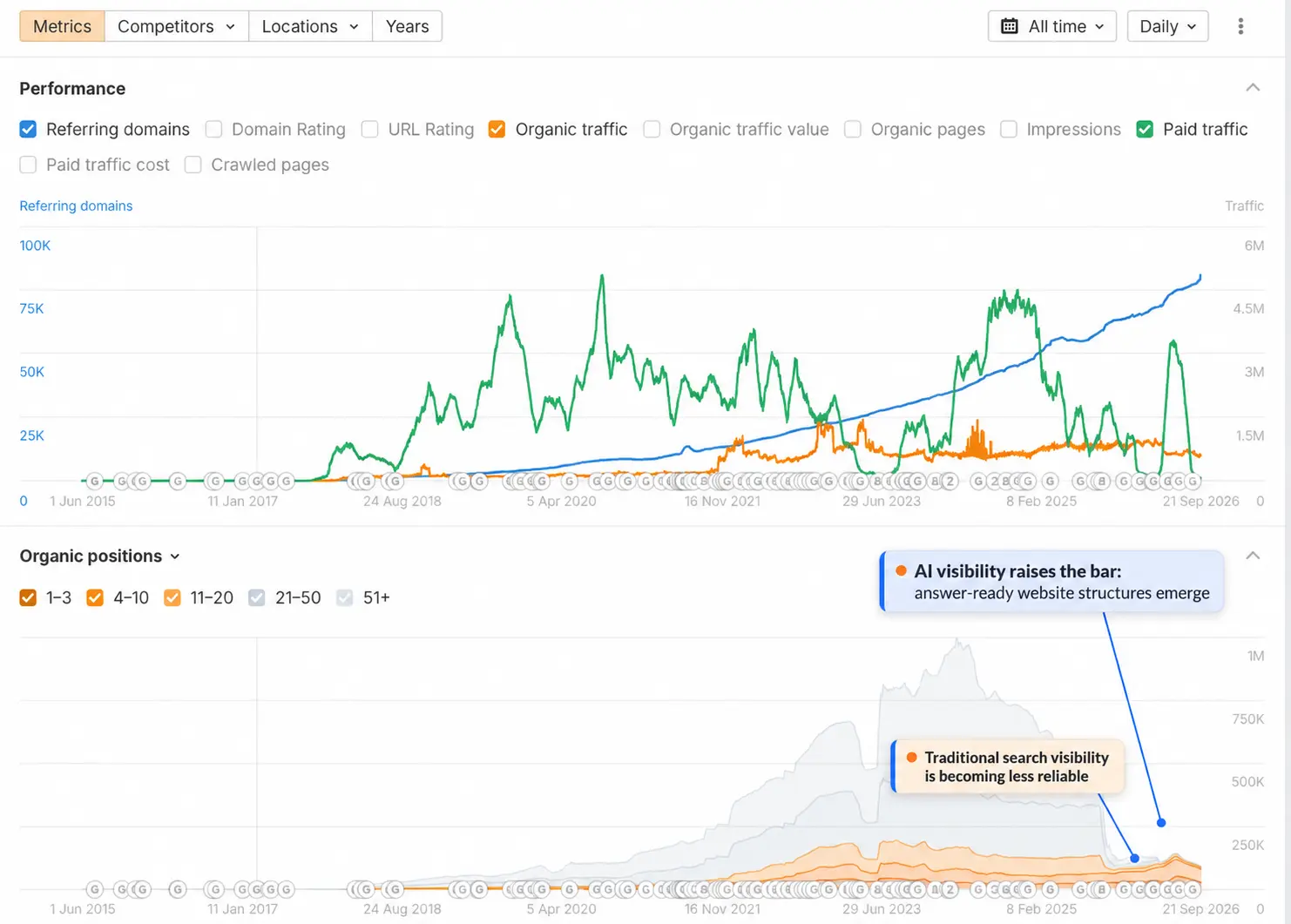
AI search changes less than the volume of commentary suggests. Google's documentation states that no special optimisations exist for AI Overviews or AI Mode, that standard fundamentals apply, and that clicks from these features appear in Search Console under the Web search type. There is no separate programme to build. The caveat worth holding is that clicks can thin out on result pages carrying an AI summary, which Pew Research Center measured on a US consumer panel over one month, most often on question-shaped searches. Watch your own click behaviour rather than anyone's headline figure: compare impressions against clicks over time for the queries you care about, starting with the question-shaped ones, and sample those questions in the assistants your buyers use.

An Ahrefs performance chart of referring domains, organic traffic and paid traffic over time, above an organic positions chart. Two annotations read: traditional search visibility is becoming less reliable, and AI visibility raises the bar, answer-ready website structures emerge
Why a clean chain from query to closed deal is getting harder to hold: traditional position tracking is becoming less reliable as answer-ready structures take on more of the visibility.

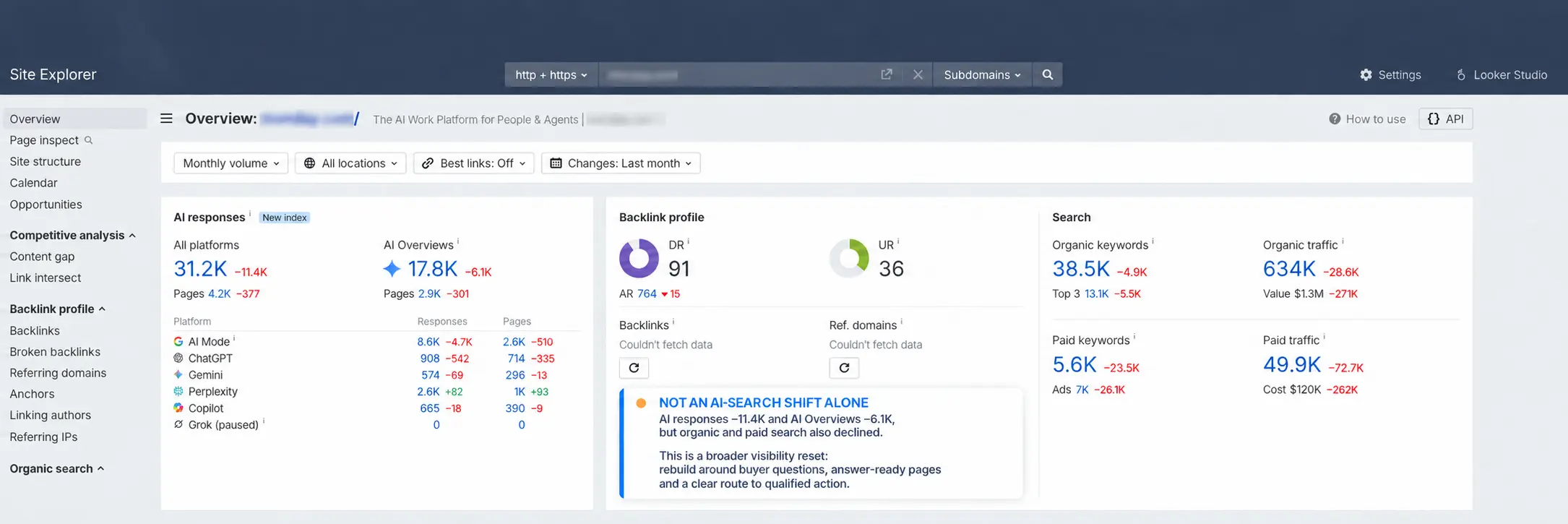
Watch the whole picture rather than the AI numbers alone. Where AI answers, organic and paid all fall in the same month, the cause is rarely the arrival of AI summaries. It is a site losing its claim on buyer questions, and the work is the same as it has always been: pages that answer those questions with proof, and a clear route from the answer to a qualified conversation.

An Ahrefs Site Explorer overview for a large SaaS site, with the domain blurred, showing last month's changes: AI responses down 11.4 thousand and AI Overviews down 6.1 thousand, alongside organic keywords down 4.9 thousand, organic traffic down 28.6 thousand and paid traffic down 72.7 thousand. An annotation reads: not an AI-search shift alone, this is a broader visibility reset, rebuild around buyer questions, answer-ready pages and a clear route to qualified action
AI answers, organic and paid all falling together on one large SaaS site over a month. The domain is blurred at source. A decline across every surface at once is a visibility problem, not an AI-search problem.

What to do first if you are starting, repairing or scaling

Most teams arrive at this from one of three positions, and the first move is different in each.

Starting means no meaningful commercial coverage in search, and usually no architecture behind the site beyond explaining the product to people who already knew about it. Resist the pull of the content calendar. Spend the first fortnight on the ICP, the buying problem and the two or three moments that matter most commercially, then build the pages closest to those decisions before anything else.

Repairing means traffic, content and some rankings, but weak pipeline, poor lead quality or a conversion path that loses people. Publishing more usually adds to the problem. Take the demand you believe is most valuable and follow one cluster the whole way through: the query, the page it lands on, the conversation it produced, and what sales said about that conversation. The weak point is rarely where the content calendar assumed it was.

Scaling means search works somewhere and nobody can repeat it. There are isolated wins and no shared basis for deciding: no agreed way to prioritise, no clear ownership across marketing, website, product and sales, and measurement that stops at the form. Agree how priorities get chosen, who owns each part of the path, and which measure closes the loop, before the next quarter's work is commissioned.

Whichever position you are in, the first question is the same one. Which demand is commercially worth pursuing, and what has to be true elsewhere in the business for that demand to become customers?

Request an Opportunity Review

A free 20-minute call for B2B SaaS and technology and high-consideration businesses with existing traffic, paid demand or product traction.

Bring the pipeline number that is behind: qualified traffic, demos, trials, enquiries or paid conversion. I’ll assess the context and identify whether there is a meaningful opportunity.

I’ll use the call to decide whether a paid Diagnostic is the right next step.