SEO should not dictate a SaaS product roadmap. Search demand and customer language should inform it when they improve market fit and qualified demand.
Anita Valentinova
Published
SEO should not dictate the product roadmap, and not every release needs a campaign. Search demand, customer language and jobs to be done should inform roadmap decisions when a feature, template, integration, data set or use case can become a useful, discoverable entry point. That takes product, search, website and activation working together before the build, not a page written after launch.
Working in-house and as a consultant for B2B SaaS companies, I have lived this sequence more often than not. Product ships a feature, an integration or a set of templates. Immediately before or after launch, someone is asked to "do the SEO for it". It usually takes education first, showing people what they should know about search and the roadmap, so they start thinking about SEO earlier.
At that point the team is asking whether the feature needs a page. What matters more was settled months earlier: whether the feature solves a problem people recognise, describe in their own words and actively look for.
I have worked across product, customer insight, growth and conversion, and my view sits in the middle. SEO should not dictate the product roadmap, and not every release deserves an SEO campaign. But search demand, customer language and jobs to be done should inform roadmap decisions when they can improve both the product's market fit and its route to qualified demand.
Most roadmap items have nothing to do with search. A permissions model, a billing change or a faster editor all matter to customers, and nobody looks for them before they know your product.
SEO deserves a place in product-roadmap decisions when the product can create useful, discoverable demand-entry points. That usually means a template, an integration, a data set or a use case that a future customer is already searching for, and that the product can show them publicly in a form that helps.
The responsibility runs both ways. Product managers can bring search in earlier. I would also expect an SEO consultant or agency to ask about the release plan, sit down with the product team and understand which features are coming, so they can think about the jobs to be done around each one. A search partner who first hears about a release from the changelog can only describe it. Which of that demand is worth pursuing is a SaaS SEO strategy decision.
Take a B2B repricing tool. An enterprise retailer and a small seller do not hire it for the same job, and neither do an Amazon seller and an eBay seller. They describe the problem differently, search differently and expect a different route to buying. Search and customer research can surface those differing jobs to be done, and they may point to different positioning, sales journeys and roadmap priorities for each segment.
Research can also tell you to do less. Consider a travel-tech company adding dynamic pricing for hotels or tour products. Before treating the release as a search opportunity, I would validate whether buyers look for it at all and what they call it. If the same company launches a spa-experiences offer, the demand may be expressed as beauty spas, wellness spas, relaxing spa days or hotel spa packages, and the offer has to meet that language. If there is no meaningful demand and no useful public asset to create, a release note may be enough.
Imagine a form builder planning forms by industry and persona. The team notices that people search for "insurance lead form", and the same need comes up in sales calls with brokers.
The after-the-fact version is a page titled "Insurance lead form builder" with a paragraph of copy, a screenshot and a signup button. It may rank, and it gives the broker very little. That gap between visibility and a useful next step is what a SaaS SEO audit should diagnose.
The roadmap version is a genuine public template. The broker can preview the working form, with the fields a broker would need: type of cover, renewal date, current insurer and consent. Beside it sits short guidance on the use case, such as which questions to ask first. One button lets them start from this template.
Then comes the part marketing cannot build alone. After signup, the broker arrives in the editor with the insurance template already loaded, not on an empty dashboard with a generic tour.
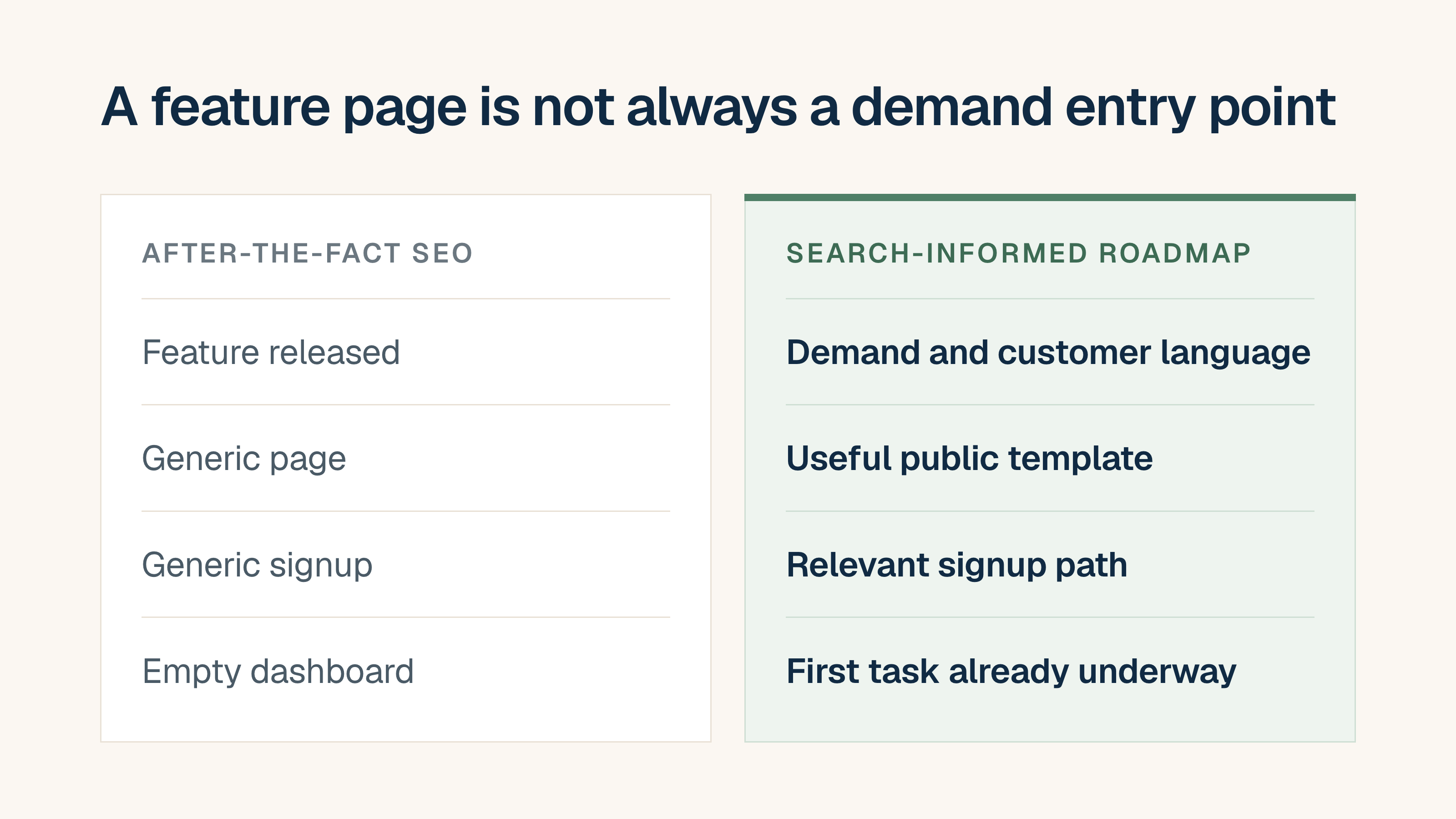
Three things are now connected:
Search discovery
The template page answers the search.
Product proof
The preview shows the product doing the job.
Activation
Signup continues the same task. The first session starts from the template the broker chose, a short step from a published form and a first lead. That early outcome is what user activation depends on.
The same thinking applies to a website builder's landing-page tool or the widgets of an enterprise CMS. Both can be designed with natural, useful routes back to the product, such as a gallery of real layouts that open in the builder, or a widget a visitor can configure before signing up. A badge link in every customer's footer is the superficial version.
When a roadmap item could become an entry point, I would put four questions to the team before anyone writes a brief.
Search data is one signal, and I would not rely on it alone. Look for the same need in sales calls, support tickets and what customers already build. "Insurance lead form" is specific: you can picture the person and the job. "Online forms" is not.
The visitor should get value before they sign up. A working preview, a usable template, real data or a clear walkthrough of an integration all qualify. If all you can publish is a description, treat it as a normal product page.
The public piece should be the product doing its job, not content sitting beside it. A template preview shows the form builder at work.
This one is skipped most often, because it sits between teams. If someone chooses a template and arrives in a blank account, the promise that brought them in ends at the registration form.
A clear yes on all four is worth planning with search in mind. One or two is more common, and building the feature for its own reasons is a perfectly good outcome.
Not every SEO-relevant decision creates a campaign or a new acquisition hub. Some are the unglamorous changes that decide whether useful demand can still find you six months later.
A help-centre migration, a documentation redesign or a new CMS capability should bring SEO in early enough to review the information architecture, existing URLs, redirects, titles and internal linking. The questions are practical: which help articles already answer meaningful customer queries? Which product, feature and integration pages should point people to the next useful step? What needs to remain indexable, be consolidated or be redirected?
Documentation often captures smaller, high-intent questions that a commercial landing page should not try to answer. A well-structured help centre can support discovery, reduce sales and support friction, and help existing customers get more value from the product.
That does not mean turning every help article into a marketing page. It means treating product documentation as part of the customer journey and preserving the paths that already work when the site changes.
Fifty template pages that nobody can use add up to content output, and pages generated mainly to rank, not to help users, are what Google's spam policies call scaled content abuse. A handful of entry points built on real demand, with product proof and a first session that continues the task, are far more likely to bring in the right buyers.
None of this means every feature needs SEO content. It means product, search, the website and activation working together on the releases where that can create qualified demand.
If you are not sure which parts of your product could work this way, or whether the pages you already have are attracting the right people, that is what I look at in a GrowthLens website and search audit. It covers the demand you could be found for, the pages meant to capture it and what happens after the click.
 GrowthLens