Not every SaaS conversion problem is a page problem. How to tell whether you need landing-page optimisation, funnel optimisation or funnel growth first.
Anita Valentinova
Published
Not every SaaS conversion issue starts with the page. Landing-page optimisation improves one step, while funnel optimisation finds where the right people lose momentum between the traffic source, the page, the conversion and what happens next. Funnel growth decides what is most worth changing first. Find where the path breaks before you decide what to rebuild.
When a B2B SaaS or technology company tells me their landing page is not converting, I take it seriously. Sometimes the page does need work. More often, in my experience, it is one part of a wider problem that started before the visitor arrived or continues after they convert.
Visitors reach a SaaS website through Google Ads, LinkedIn or Meta campaigns, organic use-case pages, comparison pages and resources they found through search. Each source sets a different expectation, and the page has to carry it forward towards a meaningful next step, whether that is a demo, a trial or a conversation with sales. When those parts do not work together, a new headline can make the page look better without changing the commercial result.
That is why I separate landing-page optimisation, funnel optimisation and funnel growth. They overlap, but they start from different problems and need different levels of work.
In practice, a funnel is the connected path between someone first encountering a company and reaching an outcome that matters commercially. I look at five key areas when I review one. Grab a coffee and focus on these in the following sequence:
The traffic source
The source is the acquisition channel, where the person came from. It tells you how ready they are likely to be.
Their intent and expectation
Intent is what they were trying to solve when they clicked. Expectation is what the ad or search result led them to believe they would find.
The relevant page
The page is where they land after the click. It needs to continue the promise that brought them there, with the same level of specificity.
The conversion action
The conversion action is what you ask them to do next, such as requesting a demo or starting a trial. The size of that commitment should match how much they now understand and trust.
What happens afterwards
This is everything after the first conversion: qualification, sales follow-up, onboarding or the first session in the product.
Take someone searching for construction management software. They may want to improve site reporting, coordinate subcontractors or stop small issues turning into project delays. A useful page shows how the software fits that job, gives them reason to trust it and offers a sensible next action. Their path then continues through qualification, the sales conversation and the internal decision, and a weak step anywhere there can look like a conversion problem on the page.
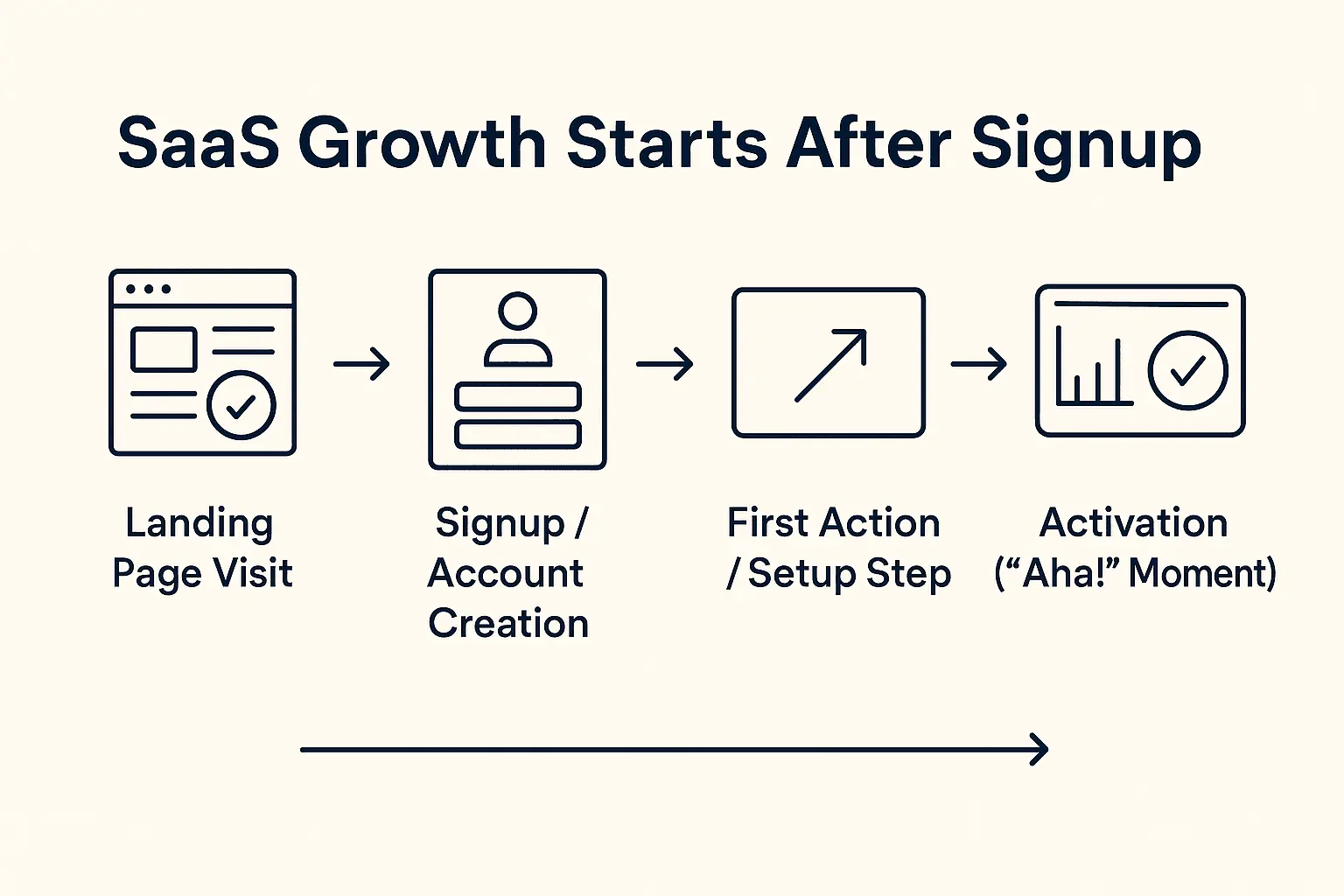
A self-serve product works differently. Someone sees a social ad, signs up for a trial and enters the product. The signup is only an intermediate conversion, and the value appears when they complete the action that made the product worth trying.
The same holds outside SaaS. I recently reviewed a digital-product funnel where people arrive from social ads, complete a free exercise and then see a paid offer. The client asked me to look at two pages, but the commercial question started with the campaign angle. Different steps, same principle: each part has to support what comes before and after it.
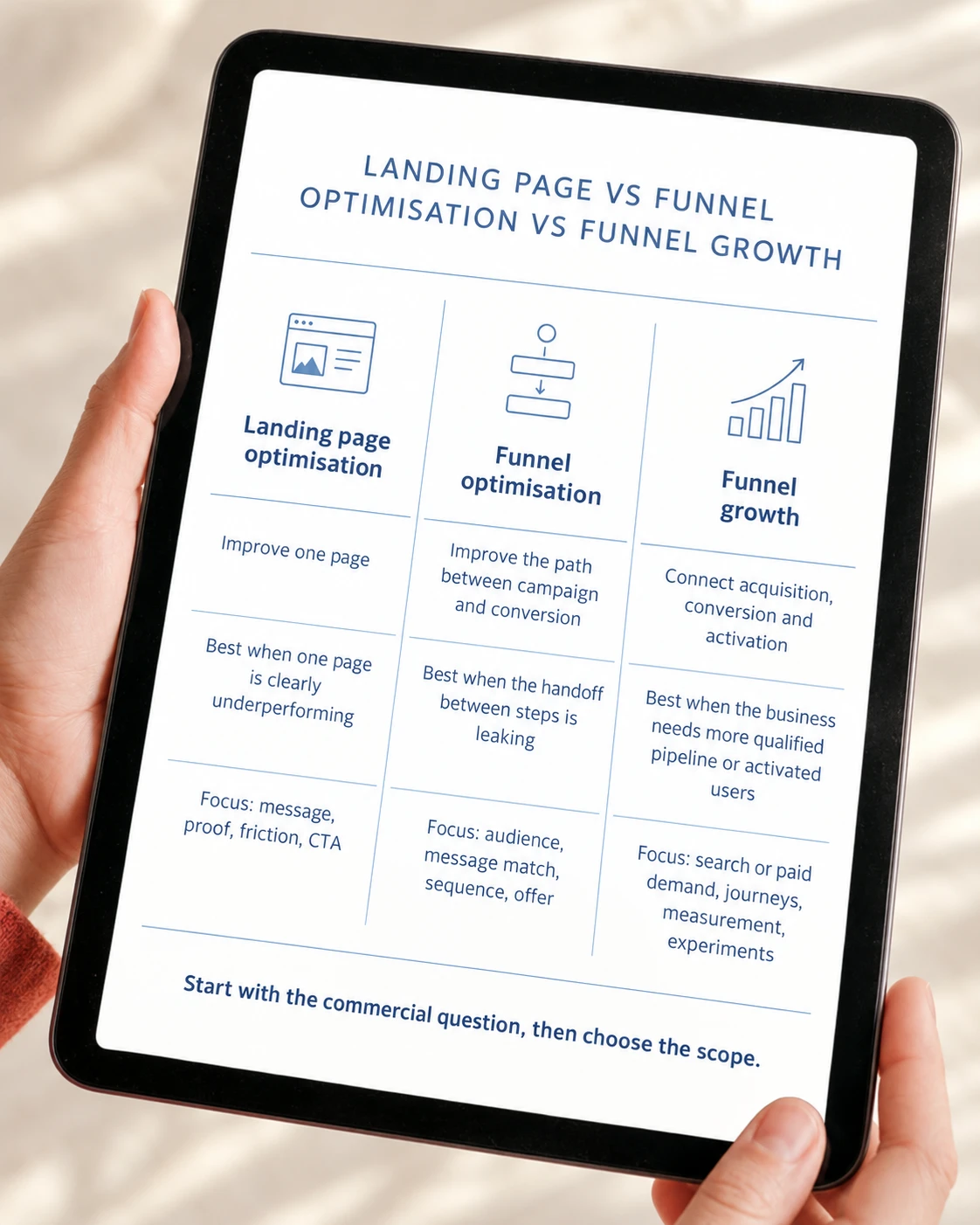
Landing-page optimisation focuses on one conversion step and what is stopping that page from doing its job. The work might cover the value proposition, proof, objection handling, structure, the form, mobile usability or how the offer is framed.
Imagine a demo page for construction management software that talks about project visibility in general terms. A project director arriving from a search about subcontractor coordination has to work out alone whether the product fits their team and why they should trust it. The form asks for budget and timeline before they have seen anything concrete, and nothing explains what happens after they request a demo.
That is a page problem, and fixing it can make a real difference when a high-intent Google Ads campaign is sending relevant visitors to a generic demo page. What a landing page cannot do is make up for the wrong audience, an unclear campaign promise, weak search intent or a poor experience after the conversion.
Funnel optimisation treats the ad, page, form and next step as one piece of work. It looks for the point where the right people lose momentum between the first click and the commercial outcome.
That usually looks familiar in the B2B SaaS world. People click the ad but do not request a demo. Demo requests come in but rarely become qualified opportunities. Trial users sign up and never reach the first meaningful action in the product. The page may be part of the answer, but so might the campaign, the offer, the sales handover or onboarding.
The issues I come across most often include:
A better page may still be part of the fix. It should come out of the diagnosis rather than being the default answer.
The source changes what the visitor already knows, what they expect and what they need next.
Not everyone who finds a SaaS website through search is ready to book a demo. Someone searching for construction management software for subcontractors wants to know whether it fits how their teams work. A finance manager researching how to reduce tax-compliance costs may still be defining the problem before looking at technology at all.
A commercial SEO page has to answer the reason someone searched, then give the right buyer a next step that fits where they are. Ranking a page is not the same as creating qualified pipeline from it. A SaaS SEO audit shows where that gap sits, from search visibility through to lead quality.
A search query tells you a lot about what someone wants at that moment. A person searching for software to simplify complex financial reporting does not need a broad homepage. They need to see whether the product solves that problem in their context, why it is credible and what they get from the next step.
If the click-through rate is healthy but relevant visitors are still leaving without acting, the landing page is worth examining closely. It may be the constraint, or it may reveal a mismatch between the promise in the ad and what the visitor finds next.
Social ads usually reach people before they are actively searching, so the page has to stay with the problem the ad introduced.
A campaign for an AI operations agent that takes repetitive work off a marketing or operations team should lead to a page showing what the agent actually does, how much control the team keeps and where it fits into their existing work. Switching to an overview of every capability makes the path harder to follow.
The conversion path does not end when someone creates an account. Consider a SaaS product that helps small businesses create and schedule social content. Early value might mean creating a first post, connecting a channel or scheduling a week of content.
A trial like this can generate plenty of signups and still underperform commercially if people do not reach that first outcome quickly enough. The constraint could sit in the trial promise, the setup flow or onboarding. Improving the signup page alone will not solve it.
Funnel growth steps back from the current page, and sometimes the current funnel, to look at where meaningful growth should come from, using what the existing funnel has already taught you.
One SaaS company may have a strong product but very little visibility for the commercial problems it solves. The most useful next move there might be a new use-case page built around a valuable search opportunity, with a clear demo or trial path. Another company may already attract the right people and lose them during onboarding. In that situation, more traffic would mostly mean paying to lose more people at the same point.
Funnel growth gives the work a commercial order, so you know whether the next effort belongs in a page, a campaign, SEO, the offer or activation before committing budget.
Start with landing-page optimisation when a defined conversion step is failing to persuade relevant visitors, and the traffic source and the rest of the path look reasonably sound. If there are several pages in the path, review all of them, not only the entry page. The first conversion is often an entry point. The commercial outcome may sit later in the path, and the earlier actions need to move the right person towards it.
Funnel optimisation is the better starting point when results drop between stages, whether that is between an ad and a page, a demo request and a qualified opportunity, or a signup and activation.
Funnel growth comes first when the real uncertainty is where to focus at all.
Yes, the three overlap. A funnel review often ends in landing-page changes, and a funnel growth assessment can show that a new offer or commercial page is needed. What differs is the level of effort, the data involved and how the work is prioritised. Not every performance problem is a page problem, so I would encourage teams not to blame the page, the performance marketer or the SEO agency until the whole path has been looked at.
Landing-page optimisation improves one conversion step, such as a demo or signup page. Funnel optimisation looks at the connected path around that page: the traffic source, the visitor's intent, the page, the conversion action and what happens afterwards. It finds where the right people lose momentum, which may or may not be on the page itself.
Funnel growth is about deciding where meaningful growth should come from next. It uses what the current funnel has taught you to choose between options such as a new use-case page, a different offer, a new acquisition channel or a better activation experience, before budget is committed to any of them.
If the traffic source brings relevant visitors and the click-through rate is healthy, but those visitors still leave without acting, the page is worth examining closely. It may be the constraint, or it may show a mismatch between the promise in the ad and what the visitor finds on the page.
A SaaS funnel includes five connected parts: the traffic source, the visitor's intent and expectation, the page they land on, the conversion action they are asked to take and what happens afterwards, such as qualification, the sales conversation or onboarding.
It depends on where people are dropping. If the right people are already arriving but leave before the demo or during onboarding, more traffic mostly means paying to lose more people at the same point. If the funnel works but too few relevant people find it, visibility is the better next move.
Not always. The first conversion is often an entry point. In B2B SaaS, the commercial outcome may be a qualified opportunity, a closed deal or an activated user, so the earlier actions need to move the right person towards it.
Do not assume the page is the problem just because it is the most visible part of the funnel.
If you are getting traffic, demo requests or signups but the right people are dropping somewhere in the path, book a free Funnel Review Call.
We will look at one priority journey together, identify whether the constraint is the traffic source, message match, landing page, offer or next step, and see how I can help with the highest-value move from there.
 GrowthLens