
Why SaaS Traffic Is Not Turning Into Demos, and How to Find the Break

Traffic can be lost at several points between the click and the sales conversation. Find the earliest break on a valuable path before blaming a channel.

Anita V. · Co-Founder of GrowthLens

LinkedIn8 min read

In short

SaaS traffic fails to become demos when one step between the click and the sales conversation is weak. Check seven in order: acquisition quality, search or ad intent, the commercial page, proof, the call to action, qualification and follow-up. The earliest weak step on a valuable path is usually where to start.

The situation usually starts with two numbers that do not agree. Organic sessions are up, the paid campaigns are spending and the blog has its best month. The demo calendar has not moved, and sales is asking where the pipeline is.

The usual reaction is to pick a suspect. The SEO agency brought the wrong traffic. The performance marketer bought the wrong clicks. The website does not convert. Any of them may be partly right, and I would not blame any of them until every step from the click to the sales conversation has been looked at.

One symptom, seven possible causes

Traffic can fail to become demos at seven points between the click and the sales conversation. Each needs different evidence and may need a different team to fix it.

  • acquisition quality
  • search or ad intent
  • the commercial page
  • proof
  • the call to action
  • qualification
  • follow-up

I go through them in that order, because an early weakness hides everything after it. A demo page cannot be judged fairly while the people reaching it were never potential buyers.
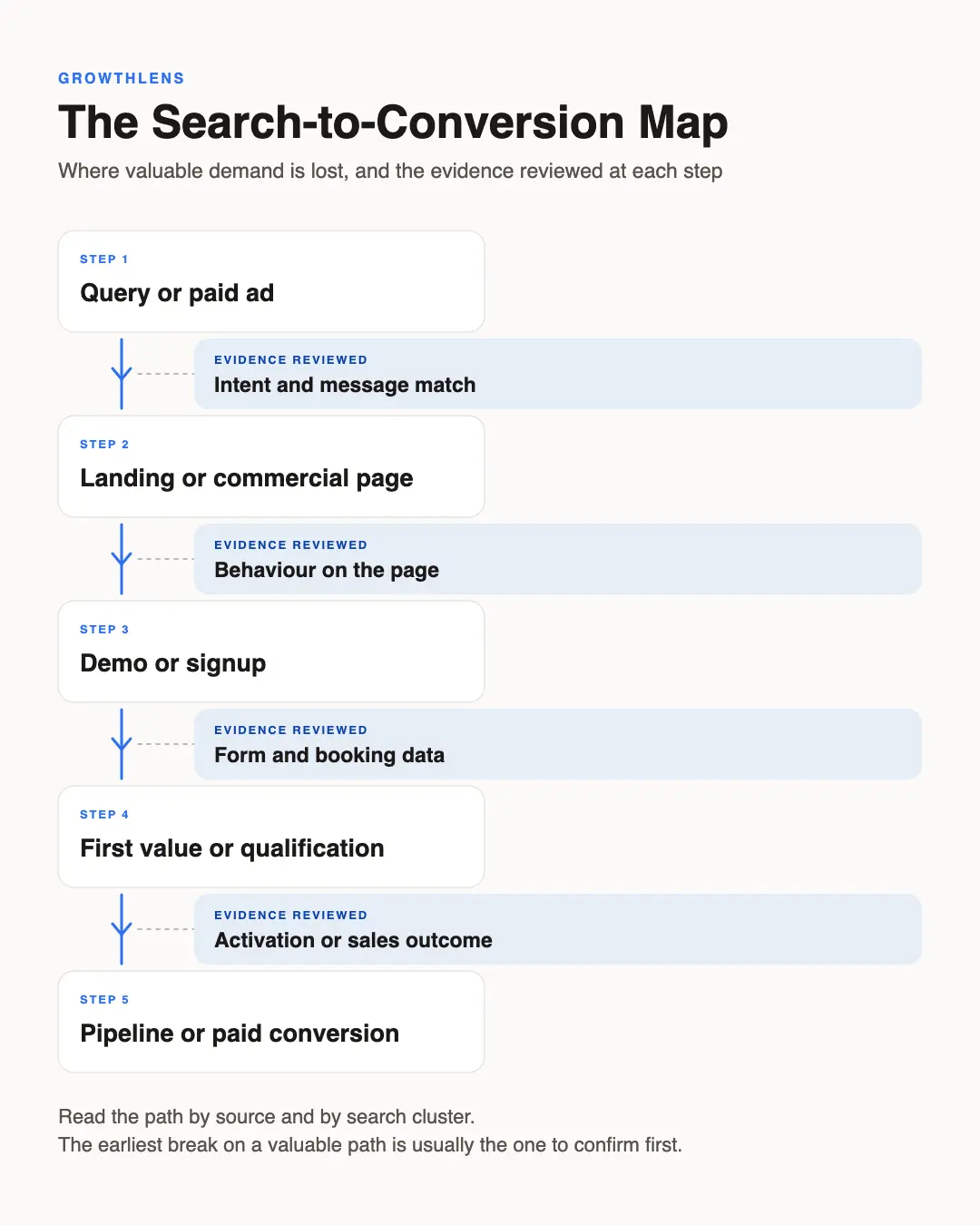
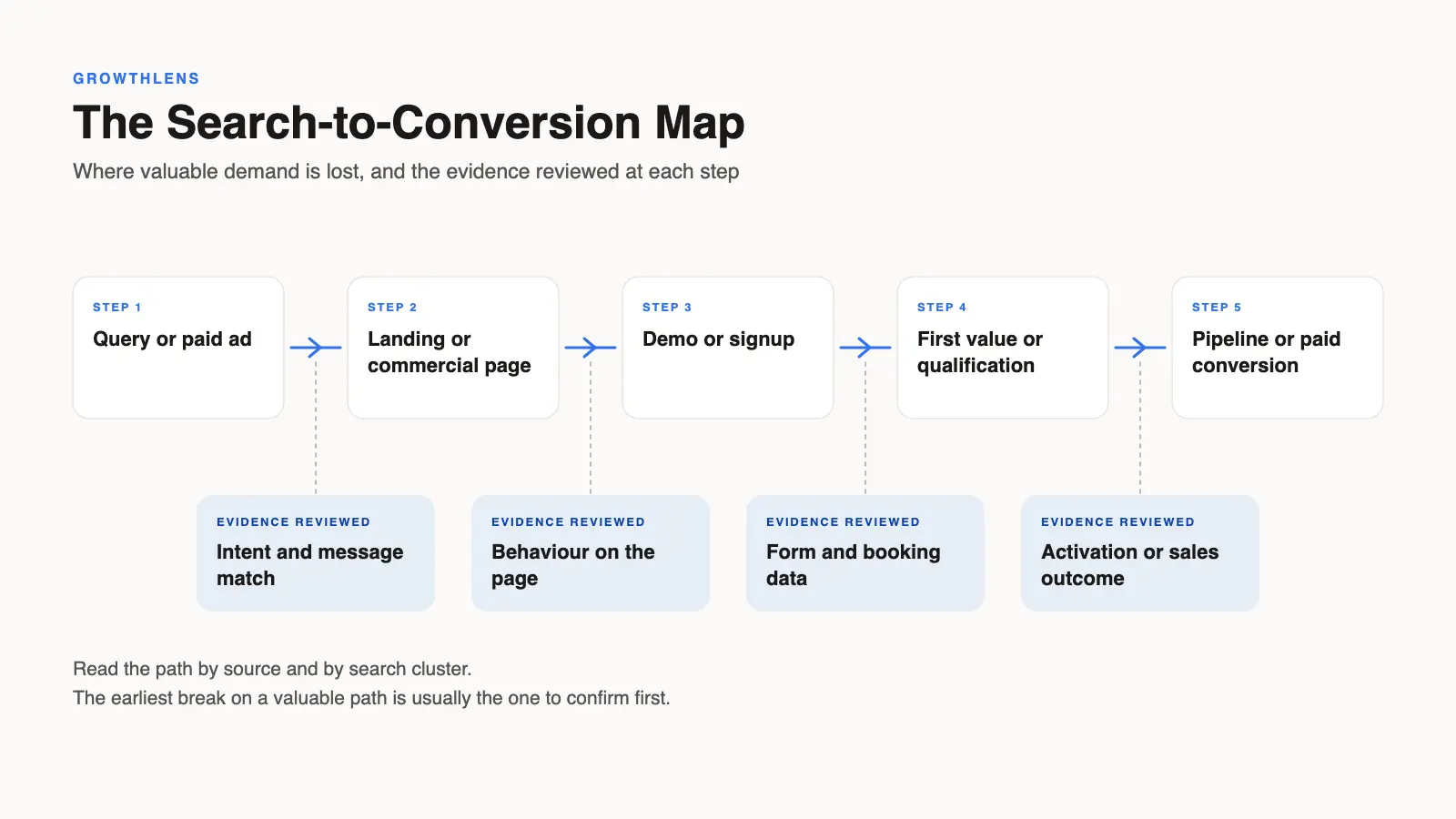
The Search-to-Conversion Map: five steps from a query or paid ad to pipeline or paid conversion, with the evidence reviewed at each handoff.
Follow one source or search cluster from the click to the commercial outcome, and check the evidence at each handoff.

1. Acquisition source

What it covers
Acquisition quality and intent: organic search, paid search, paid social, referrals, and the query or the promise in the ad
Evidence inputs
Search Console queries, ad search terms and copy, entry pages by source, the ICP definition
What a break looks like
Traffic that could never buy. Relevant people at the wrong moment

2. Commercial page

What it covers
The page and its proof: use-case, product, feature, comparison, pricing and demo pages
Evidence inputs
Live results for the query, page analytics by source, recordings, sales questions and objections, a proof inventory
What a break looks like
No commercial page for the search. Promise dropped. Claims without proof

3. Demo or signup

What it covers
The call to action, qualification and follow-up: the request or the signup and the first response
Evidence inputs
Form analytics, routing and qualification rules, time to first reply, held-meeting rate
What a break looks like
Ask too large. Fields nobody uses. Slow or generic follow-up

4. Activation or paid

What it covers
The outcome: first value in the product, or an opportunity sales accepts
Evidence inputs
CRM acceptance and win reasons, product analytics for the first key action, support and onboarding tickets
What a break looks like
Demos sales declines. Signups that never reach first value
The seven checks fall into four stages. Read every stage by source and by search cluster.

Acquisition quality: could these visitors ever buy?

Begin with who is arriving. Split traffic by source, campaign and landing page, and for each one ask whether the visitors could plausibly become customers.

A SaaS blog can attract students, job seekers, competitors and people in markets the company does not sell to. That traffic is real, and it inflates the total. Paid campaigns do the same thing in a different way, when broad match terms or wide audience targeting bring clicks from outside the ICP.

The quickest check is to separate commercial entry pages from everything else. Look at sessions that begin on product, use-case, comparison, pricing and demo pages, and compare them with sessions that begin on informational content. If most traffic enters through articles that have no relationship to a buying decision, the gap between traffic and demos may start with which search demand the site is built to win.

Search and ad intent: what were they trying to do?

Relevant visitors can still arrive at the wrong moment. Intent is what the person was trying to do when they clicked.

Consider two people who both work in finance operations at a mid-sized company. One searched for how to reduce the cost of tax compliance. The other searched for a specific product category with the word "software" and a competitor's name. Both fit the ICP. Only the second is evaluating vendors this month.

Read the queries and the ad copy behind your main landing pages and sort them by moment: defining the problem, exploring approaches, comparing options, ready to talk. Then check what each landing page asks for. A page that receives problem-defining traffic and offers only a demo request is likely to convert poorly. The ask comes too early for that visitor.

The commercial page: is there one, and do they reach it?

A site can have plenty of content and very few pages built to help a buyer decide. The visitor reads a useful article and finds no obvious route to a page about their use case.

Two things are worth checking. First, whether a commercial page exists for each valuable search cluster and campaign: a use-case, solution, comparison or product page that continues what the visitor came for. Second, whether informational pages link to it in a way a reader would follow, in the text and at the point where the article raises the problem the product solves.

Where the page exists and still does not hold people, look at how well it matches the search that brought them. Titles, headings, structure and internal links are covered in SaaS on-page SEO for commercial pages.

Proof: why should they believe it?

A buyer who has found the right page still needs a reason to trust it. In B2B they also need something they can show a colleague.

Check whether the proof on the page matches the visitor. Customer names from a different industry or company size do less than one example from their own. Claims with no evidence behind them, such as "trusted by leading teams", do very little. Look for what is missing for the people who will join the decision later: security and compliance detail for technical evaluators, pricing logic for the budget holder, implementation effort for the team that has to adopt it.

Ask sales which proof moves conversations forward, and check whether it is on the website.

The call to action: is the ask the right size?

A demo request is a large commitment. It costs the visitor time, exposes them to follow-up and often requires them to justify the meeting internally. Someone who is still comparing options may want something smaller first.

Look at what each page offers. If the only next step on every page is "Book a demo", visitors who are interested and not yet ready have nowhere to go. A recorded product tour, a pricing page that answers real questions, a comparison guide or a trial where the product allows it can keep them moving. The first conversion is often an entry point. The demo may come later.

Check the opposite case too. A page for ready buyers that hides the demo request below long content is making a simple step hard.

Qualification: who gets through, and who is turned away?

Qualification happens in the form, in the routing rules and in whoever reviews requests. It can lose good buyers and admit poor ones at the same time.

Review the form fields against what sales uses. Review any rule that rejects or deprioritises requests, such as personal email addresses or company size. Qualification rules are often set at an earlier stage of a company and left unchanged. Check them against the deals you have actually won.

The demo page has its own set of checks, set out in how to optimise a SaaS demo page for conversion.

Follow-up: what happens after the request?

After the request, someone has to respond. Measure the time from form submission to first reply, the share of requests that become a held meeting and the share sales accepts as an opportunity.

A slow or generic response can undo everything before it. So can a first call that repeats questions the form already asked. When requests are arriving and held meetings are not, the constraint is likely to be in the follow-up, and website changes will not move it.

Reading the path in order

Take one valuable journey, for example organic use-case pages to demo, and put one number against each step:

  • share of traffic that fits the ICP
  • share entering on or reaching a commercial page
  • share engaging with the next step
  • share completing the request
  • share accepted by sales

Acquisition quality

Number to put against it
Share of traffic that fits the ICP
Where it comes from
Source and entry-page split, sales tagging

Commercial page

Number to put against it
Share entering on or reaching a commercial page
Where it comes from
Analytics

Call to action

Number to put against it
Share engaging with the next step
Where it comes from
Analytics, form analytics

Qualification

Number to put against it
Share completing the request
Where it comes from
Form analytics

Follow-up

Number to put against it
Share accepted by sales
Where it comes from
CRM
One path, five numbers. A number you cannot produce is itself a finding.

You will not have all of them cleanly, and that absence is itself a finding. The earliest step where the numbers fall away, on a journey that matters commercially, is usually the one to confirm first. Confirm it with sales notes or recordings before acting, because every number has more than one explanation.

What I would not conclude too quickly

Traffic and demos can separate for reasons that have nothing to do with these seven checks. Tracking changes, consent settings and CRM rules can remove demos from a report without a single buyer behaving differently, so rule out measurement early. If the search side of the picture is unclear, with visibility or clicks falling at the same time, a SaaS SEO audit is the fuller diagnosis.

And once you know the constraint, resist turning the fix straight into a split test. Whether to test or validate another way depends on the volume and the decision, which is what the Evidence Threshold is for.

Frequently asked questions

Why is our website getting traffic but no demo requests?

Usually one of seven things: the visitors could never buy, they are too early for a demo, there is no commercial page for them to reach, the page lacks proof, the ask is too large, qualification turns them away, or follow-up is slow. Check them in that order on one valuable path.

How do we know if traffic quality is the problem?

Split sessions by entry page and source. Compare sessions that start on product, use-case, comparison and pricing pages with those that start on informational articles. Then follow each source into the CRM. If demos from a source are consistently declined by sales, the quality of that source deserves a closer look.

Is it a conversion problem or an SEO problem?

Often it is both, at different stages. If the site is not visible for searches close to a buying decision, that is a search problem. If relevant buyers reach commercial pages and leave, that is a conversion problem. Splitting traffic by intent and entry page usually shows which one is larger.

Should we add more demo call-to-action buttons?

Only on pages where visitors are ready for that step. Adding a demo button to every article rarely helps, because most readers there are earlier in the decision. Give those readers a route to a relevant commercial page, and give commercial pages a clear request and a smaller alternative.

How long should it take to respond to a demo request?

As quickly as your team can do it well. I would not quote a benchmark without a source. Measure your own time to first reply and the share of requests that become held meetings, then see whether faster replies change that share.

Where should we start if we do not have CRM data by source?

Begin with what you have: entry pages, queries and form completions by source. Add a self-reported "how did you hear about us" field and ask sales to tag recent demos by quality for a month. It is imperfect, and it is usually enough to see which step is weakest.

What to do this week

Pick one journey that matters commercially and put a number against each step, even a rough one. Adding traffic before you know where buyers drop out mostly means losing more people at the same point.

If you need to decide whether the next budget belongs in search or conversion, read SEO vs CRO for B2B SaaS.

If you need a structured diagnosis of one priority path, see how a SaaS conversion diagnostic works.

Further reading

Request an Opportunity Review

A free 20-minute call for B2B SaaS and technology and high-consideration businesses with existing traffic, paid demand or product traction.

Bring the pipeline number that is behind: qualified traffic, demos, trials, enquiries or paid conversion. I’ll assess the context and identify whether there is a meaningful opportunity.

I’ll use the call to decide whether a paid Diagnostic is the right next step.