What to look for in an experimentation platform for B2B SaaS, when you do not need one yet, and how to pick and measure your first five experiments without one.
Anita Valentinova
Published

A B2B SaaS team needs an experimentation platform when a step has steady traffic, one clear conversion event and enough volume to reach a result. Before that, combine qualitative and quantitative evidence to choose your five most promising changes, then measure each one before and after. When you do buy, choose a platform that lets you question the data and act on it quickly.
When a B2B SaaS team asks me which experimentation platform they should buy, the conversation usually starts with tools. Someone has seen a competitor run tests, a board member has asked about the testing roadmap, or the growth lead wants to stop arguing about headlines. The shortlist arrives before anyone has checked whether the product can support a test yet.
The tool matters. In my experience, though, it is the second decision. The first is whether your traffic and your conversion events can produce a result you would trust. Some products are not there yet, and for them a different approach does more good than a platform licence.
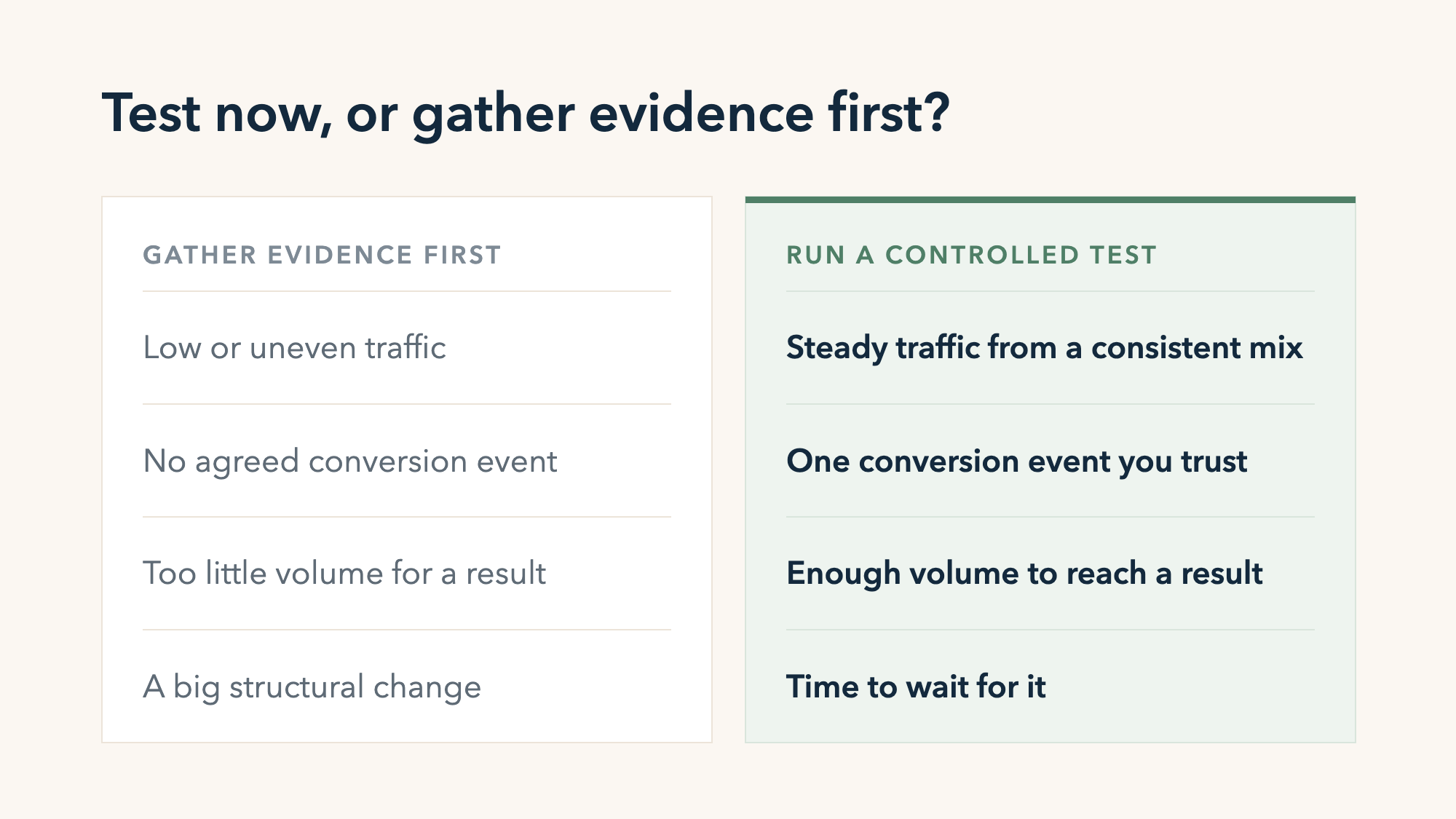
A controlled test needs three things on the step you want to change: steady traffic from a consistent mix of sources, one conversion event the business trusts, and enough volume to detect the size of change you care about within a sensible time.
Many smaller B2B SaaS products do not have that on their most important steps. A demo page might receive a modest number of requests a month. A trial might bring in enough signups, but activation is spread across several actions that nobody has agreed on. In both cases a platform can be installed and configured, and the tests it runs will still struggle to conclude.
That is why I check the evidence first. I set out how I decide between investigating, validating and testing in the Evidence Threshold. If the answer for your priority steps is not yet a controlled test, the platform can wait.
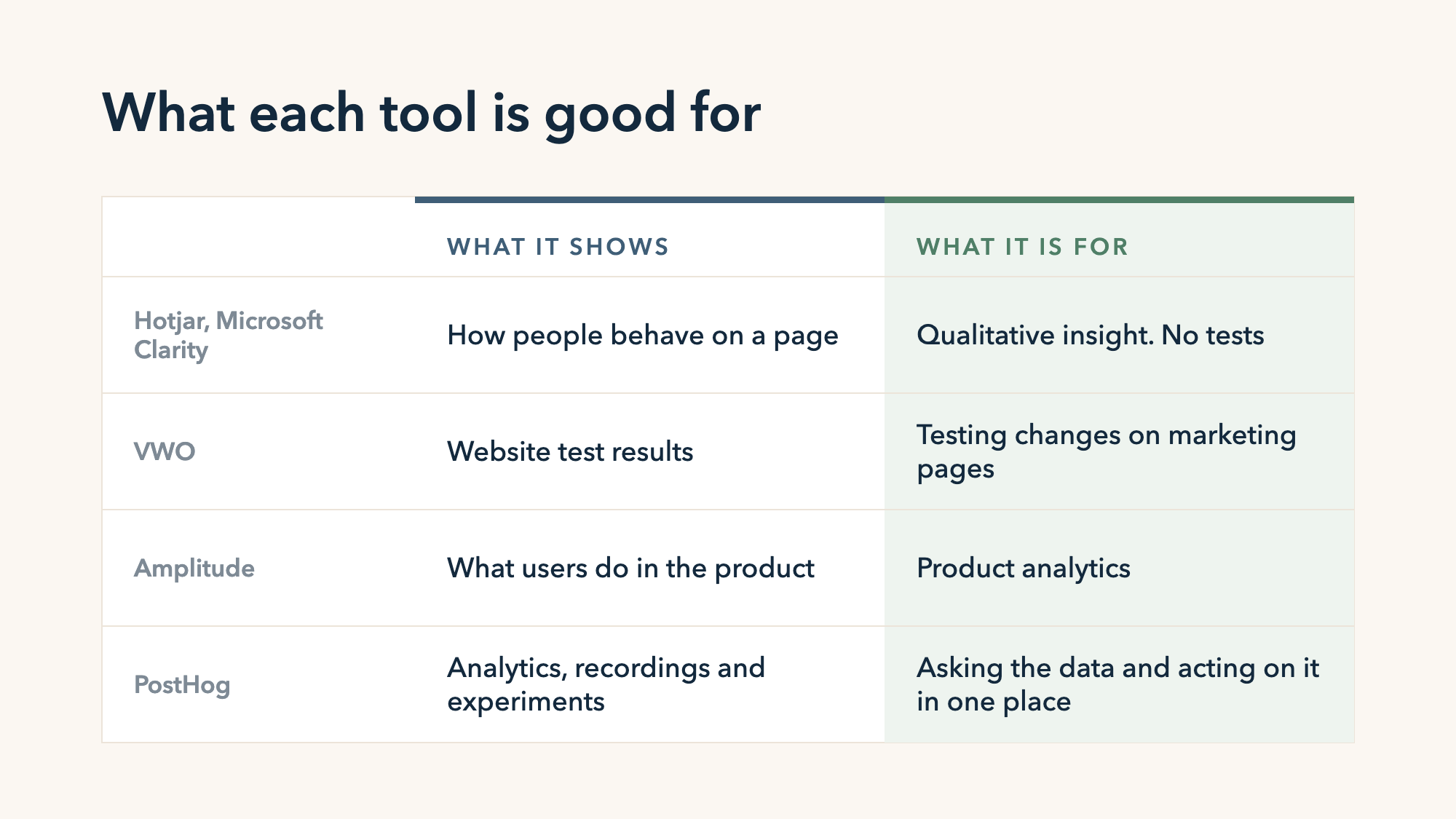
I have worked with Amplitude, VWO, PostHog, Hotjar and Microsoft Clarity. They do different jobs, and it helps to be clear about which job you need done.
Hotjar and Microsoft Clarity
These are qualitative tools. Recordings and heatmaps show what people do on a page: where they hesitate, what they ignore, where a form loses them. They do not run tests. In my experience they are also not where I question the data and make a decision quickly. They show me the behaviour, and I still need to work out what it means somewhere else.
VWO
VWO is a testing tool for the website. It is useful when the change lives on a marketing page, such as a headline, a layout or a form, and the page has the volume to support a test.
Amplitude
Amplitude is product analytics. It is built for following what users do inside the product, across events and over time.
PostHog
PostHog is the one I enjoy working with most. It brings product analytics, session recordings and experiments into one place. What I value most is that I can write my own prompts against the data, drill down into a segment or a step and act on what I find, without moving between three tools to answer one question.
None of these is the right answer for every team. The right tool depends on where your changes live, who builds them and what you need to see afterwards.
If your traffic does support testing, these are the things I would check before buying.
Where the change lives
A change on the marketing site and a change inside the product are tested differently. Website tests often rely on a visual editor or a script on the page. Product tests usually need feature flags and engineering time. Check that the platform suits the place where most of your changes will happen.
Who builds the variants
Someone has to design and build each variant. If that is your engineering team, the platform needs to fit how they already ship. If it is marketing, they need to be able to make changes without a developer for every test.
Whether it connects to the outcome that matters
A test that only counts form fills or signups can pick a winner that sales later rejects, or that never activates. Check whether the platform can connect each variant to what happened next, in the product or in the CRM.
How it handles sample size and stopping
Results that are checked every day and stopped when they look good are easy to misread. A platform that asks you to plan the sample size and duration before the test starts helps the team stay honest.
How quickly you can get to a decision
Dashboards are useful only if someone can question them. Check how easily you can segment a result, look at the sessions behind it and decide what to do next.
Whether it covers the qualitative side
Numbers tell you where people drop. Recordings, surveys and interviews help explain why. Some teams want both in one place. Others are happy with a separate qualitative tool.
Some products do not support experimentation until they have more traffic. That is not a reason to stop improving the website or the product. It changes how you choose what to work on and how you judge whether it worked.
Here is the approach I use when a controlled test is not yet possible.
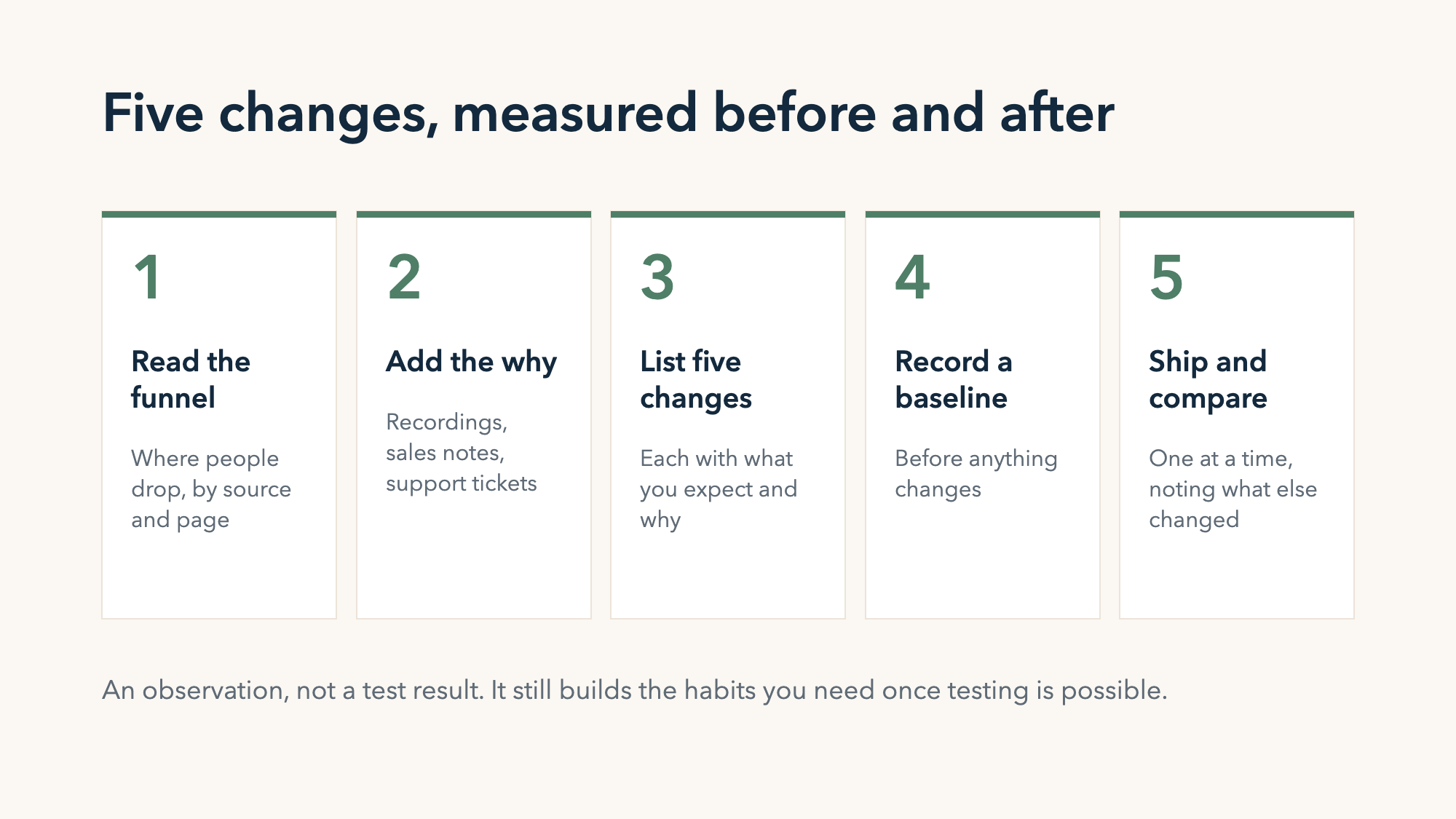
This is weaker evidence than a controlled test, and I would always describe the outcome as an observation, not a test result. It is still a disciplined way to improve a site with limited traffic, and it builds the measurement habits you will need once testing becomes possible. If you want the longer argument, I wrote about it in what to do before A/B testing in B2B SaaS.
Start with the steps that matter commercially, such as the demo page, the signup or the first session in the product. For each one, ask whether it has the traffic and the conversion event to support a test. If it does, the platform choice becomes practical, and the checklist above will narrow it down. If it does not, start with qualitative and quantitative evidence, a shortlist of five changes and a before-and-after baseline.
Yes, a platform can still be worth having early. Product analytics with recordings in one place helps even when you are not running tests yet. What I would avoid is buying a testing licence before the evidence work has been done, and then judging the team on how many tests it runs.
When testing is possible, I plan the tests and analyse the results, and the client's team builds the variants. That keeps the testing close to the people who own the product.
Not always. A team needs one when a priority step has steady traffic, one clear conversion event and enough volume to reach a result in a reasonable time. Before that, qualitative and quantitative evidence can identify the five most promising changes, and a before-and-after comparison can show whether each one helped.
Check where your changes live, on the website or inside the product, and who will build the variants. Check whether the platform connects each variant to later outcomes, such as activation or sales acceptance, how it plans sample size and stopping, and how quickly you can question a result and decide what to do.
They are qualitative tools. Recordings and heatmaps show what people do on a page, which helps explain why a step loses people. In my experience they are not where I run tests or question the data to make a decision, so they work best alongside an analytics or testing tool.
Combine the funnel data you have with recordings, sales notes and support tickets. Use them to list the five changes most worth making, record a baseline for each, then ship and compare before and after. Describe the result as an observation, and note anything else that changed in the same period.
Usually the team that owns the page or the product. On a marketing site that may be marketing with a visual editor. Inside the product it is usually engineering, using feature flags. In my work, I plan the tests and analyse the results, and the client's team builds the variants.
Do not start with the tool. Start with whether your most important steps can support a test, and what you would do instead if they cannot.
Website growth starts with experimentation. What do you change first? Let's talk.
 GrowthLens