Why Complex SaaS Products Convert Better With a Demo Than a Free Trial
Free trial is not always the right answer
The default assumption in SaaS acquisition is that removing friction always improves conversion, and for a decade that assumption drove nearly every product-led growth strategy toward the same endpoint: make the** free trial **as easy to start as possible, get users inside the product, and let the experience sell itself. For simple, low-complexity tools with short time-to-value and minimal onboarding requirements that logic holds and in fact they usually need dianogistics to make these pieces convert. However, for complex, high-consideration SaaS products where value only becomes visible after meaningful configuration, team involvement, and workflow integration, a free trial is not a low-friction entry point. It is a funnel that fills with the wrong people and empties without producing revenue.
The problem is not that free trials attract too few users, but it gets those who are not ready to buy, who explore without direction, who form impressions of the product based on an incomplete experience, and who leave before reaching the outcome that would have justified a purchase decision. The sales team then inherits a pipeline of low-intent contacts who engaged with the product in its least compelling state and now need to be convinced that what they saw was not representative of what the product actually does. That is an expensive and structurally broken acquisition model for any product that requires context or any technical integration to demonstrate its value.
A demo-first acquisition model inverts that dynamic by treating the entry point itself as a qualification mechanism rather than a volume driver.
What a Free Trial Actually Does to a Complex SaaS Funnel
When a complex SaaS product leads with a free trial, three structural failures tend to compound each other in ways that are difficult to diagnose from aggregate conversion data alone.
-
The first is the time-to-value gap. Complex products require configuration, integration, and often team participation before they produce an outcome meaningful enough to justify a purchasing decision. A user who starts a trial alone, without guidance, encounters an empty or unconfigured environment and spends their available attention on setup rather than on experiencing the product's core value. Most of them leave before reaching the point where the product becomes genuinely useful, not because the product failed them, but because the trial structure never gave them a realistic path to understanding what it could do.
-
The second failure is what happens to the prospects who would have been the strongest buyers. Sophisticated buyers at the enterprise or mid-market level, the ones with genuine budget authority and defined operational problems, often do not want to self-serve through a trial. They want to see the product applied to their specific situation, to understand how it would fit their existing workflows, and to have their questions answered by someone who understands both the product and the problem it solves. A free trial as the primary CTA tells those buyers that the expected path is self-directed exploration, which is not what they came for. Many of them disengage before the sales team ever knows they were there.
-
The third failure is timing. When a trial-first funnel eventually routes a user toward a sales conversation, it happens after that user has already formed an opinion about the product based on an experience that was almost certainly incomplete and possibly misleading. The sales conversation then has to overcome a first impression rather than build on one, which is structurally harder and more resource-intensive than having the sales conversation before the product experience, when the user's understanding is still open rather than anchored.
Why a Demo-First Funnel Performs Differently

A demo-first acquisition model does not remove friction from the funnel. It relocates friction to the point where it does the most useful work, which is before a prospect enters the pipeline rather than after.
Asking a prospect to book a thirty-minute call in order to see the product is a non-trivial commitment. Someone who is casually curious will not make it. Someone with a defined problem, a realistic budget, and the authority or influence to move a purchasing decision forward generally will. The act of booking itself becomes a self-selection mechanism that filters for intent before any sales resource is deployed, which means the pipeline that results from a demo-first model contains a higher proportion of prospects who are worth the investment of a sales conversation.
The demo itself, when structured correctly, also produces a fundamentally different prospect psychology than a self-directed trial. A prospect who has watched a guided demonstration of the product applied to a problem that resembles their own enters any subsequent conversation with a concrete sense of what the product does and a specific set of questions about fit and implementation rather than a vague impression formed from incomplete self-exploration. That prospect is closer to a buying decision after a thirty-minute demo than most free trial users are after two weeks of self-directed access.
The reframing that drives this difference is in how the product is positioned at the point of first contact. A free trial CTA communicates that the product is something you try on your own to see if you like it. On the flip side, a demo CTA communicates that the product is a professional tool that warrants a guided introduction, that the value is substantial enough to deserve thirty minutes of a buyer's time, and that the practice of understanding your specific situation before showing you the product is part of how the company operates. That positioning is itself a trust signal for buyers at the level of sophistication and budget that complex SaaS products depend on.
Real Funnel Teardown: How Solidroad Structures a Demo Acquisition Flow
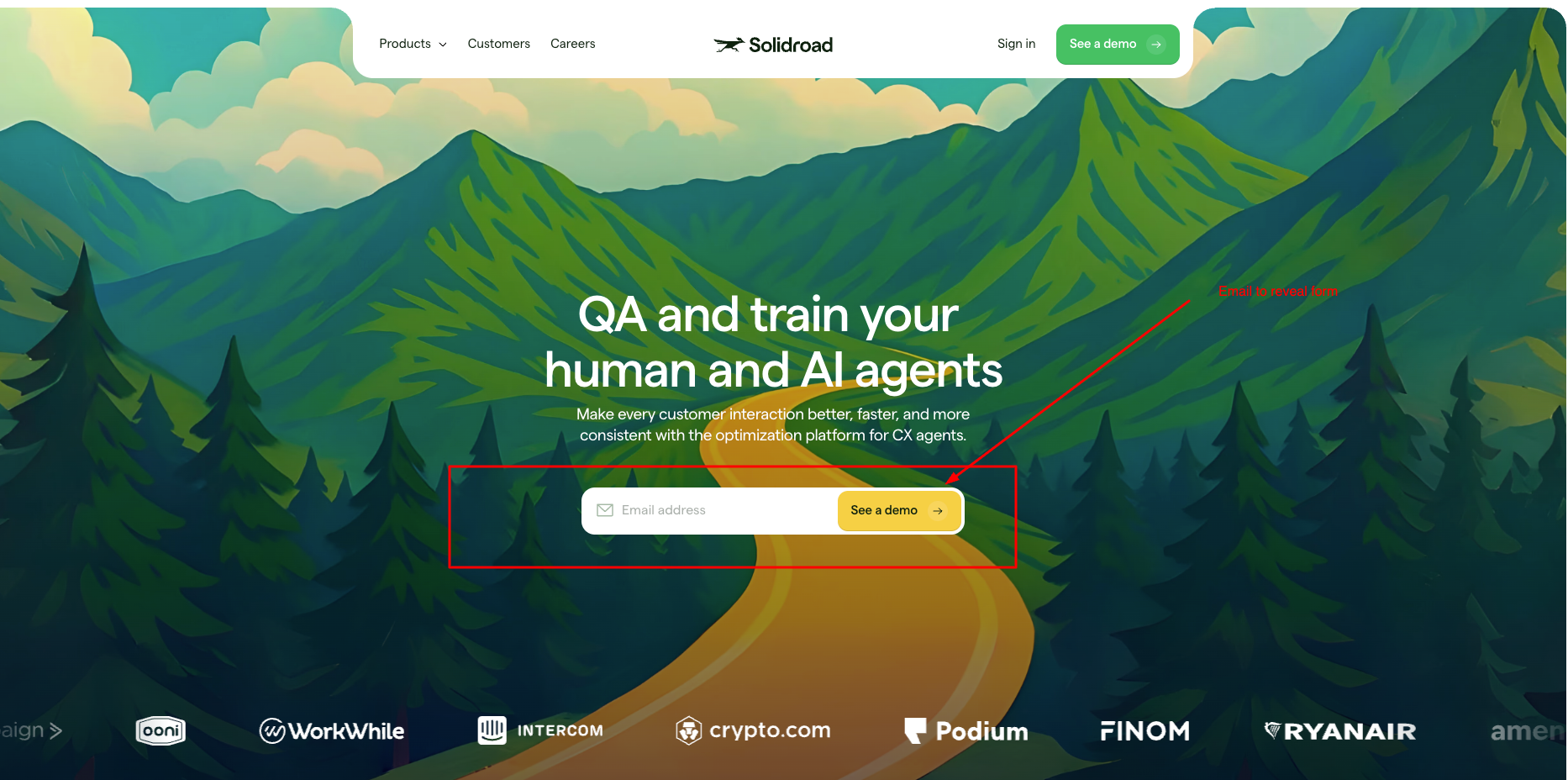
Solidroad, an AI-powered sales coaching and conversation intelligence platform, operates in a category where the value proposition is genuinely complex, where implementation involves workflow integration and team behaviour change, and where the buyers are revenue leaders and sales operations professionals who make considered purchasing decisions. Their acquisition architecture reflects a deliberate choice to optimise for qualified pipeline over signup volume, and the mechanics of how they execute that choice are worth examining in detail.
The entry point is an email capture, not a full registration form. The page asks for a single field, which feels low-commitment but serves a specific technical purpose: the email is captured into the CRM the moment it is submitted, before the user completes any subsequent step, which means that anyone who starts the process but does not finish booking a demo can be re-engaged through an abandoned booking sequence. The initial low-friction feeling of the email field is a deliberate design choice that serves the practice's pipeline hygiene rather than simplifying the process for the user's benefit.
Once the email is submitted, only then the form expands to collect name and company. By this point the contact is already in the system, so the additional fields serve qualification rather than capture. The information collected at this stage enables segmentation before any sales conversation happens, which means the person who will run the demo already has relevant context about who they are speaking with and can prepare accordingly. The thing I´d change here is to add the microcopy for a work email at the very first step to meet user´s expectation and avoid frustration.
The booking step routes to a dedicated URL rather than embedding a calendar widget in a modal on the existing page. The distinction matters for several reasons beyond aesthetics. A dedicated URL is a standalone conversion asset that can be used in** paid retargeting campaigns, email signatures, cold outreach sequences**, and follow-up communications without requiring any additional page infrastructure. It also creates a clear psychological transition, moving the prospect from information gathering to commitment, which reinforces the sense that booking a demo is a specific and meaningful action rather than a casual next step in a browsing session.
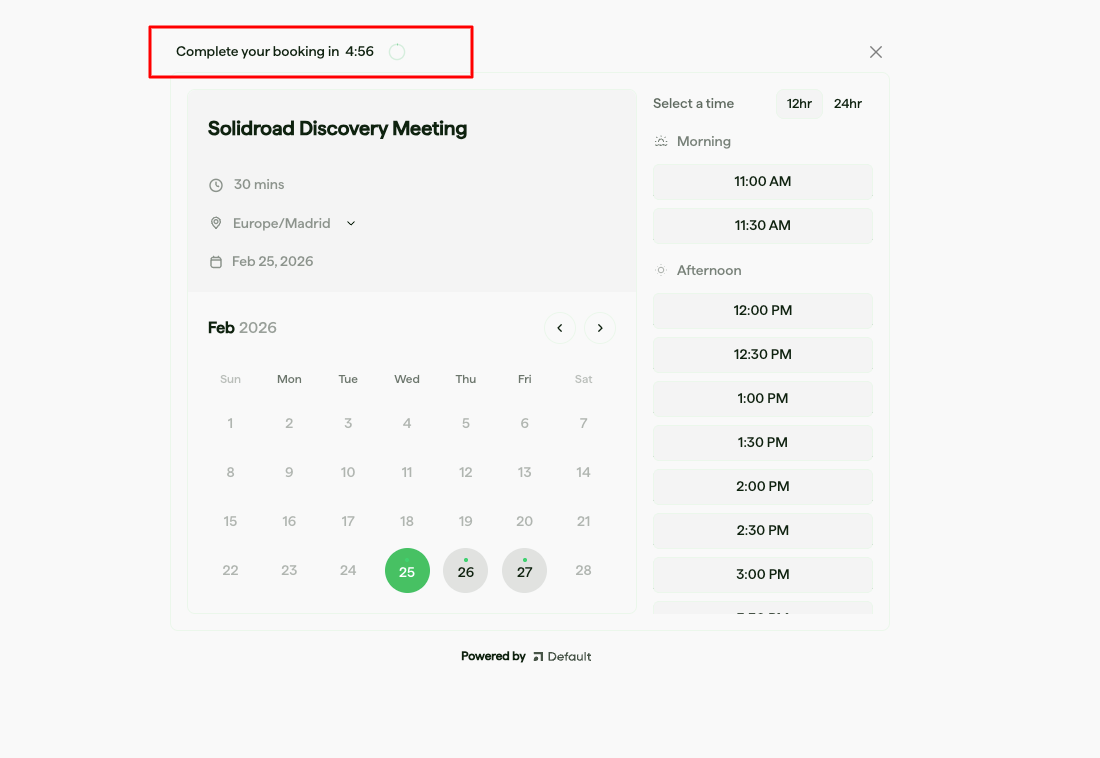
The booking interface includes a countdown timer showing available time in the current booking window alongside the timezone, date, and duration of the call. The timer creates what behavioural economists call availability scarcity, a signal that the slots on offer are finite and in demand, which reduces the tendency toward tab abandonment that quietly kills conversion in booking flows where the prospect intends to return later and never does. The explicit display of timezone, date, and duration removes all scheduling ambiguity, which reduces no-show rates by ensuring that the prospect knows exactly what they have committed to and when. The only thing which doesn´t fit the bill is that the message before the calendar showed ¨Thank you.We will contact you shortly.¨ while the next page shows the booking calendar. Would I get contacted or not?
The analytics layer that should sit behind a funnel structured this way tracks conversion velocity across five events: email submitted as a measure of baseline interest, form completed as a qualification rate, calendar page loaded as intent-to-book, demo booked as the final conversion event, and attendance as the downstream metric that determines whether the pipeline entering the sales process is actually showing up for the conversation they requested. Each of these events represents a distinct stage in the prospect's progression toward a purchasing decision, and the ratios between them reveal where the funnel is leaking rather than requiring inference from aggregate data.
Legal Tech Case: What Happens When Trial Friction Hits at the Wrong Moment
A document automation platform in the legal tech space presented a different version of the same structural problem. The product itself was strong, offering professionally drafted, lawyer-reviewed contract templates built through a guided document creation flow. User acquisition was generating consistent traffic and sign-up volume. The conversion from completed document to payment was where the funnel collapsed.
The specific failure was a surprise paywall appearing at the point of download. Users who had invested time navigating the document creation flow, answering questions, and generating a document they believed was ready to use encountered a payment demand at the moment they attempted to retrieve what they had built. The experience of having worked through the product and then being asked to pay at the final step, without having been clearly informed that the download action was gated, produced abandonment rates that were destroying the economic viability of the acquisition spend generating that traffic.
The surrounding experience compounded the trust damage. Preview functionality had bugs that prevented users from confirming whether their generated document was correct before being asked to pay for it. Premium features were grouped into overflow menus without clear labelling to indicate which actions were gated, so users navigating the interface had no reliable way to understand what was included in their current access and what required payment. Upgrade prompts when they appeared were generic, describing plans without connecting them to specific outcomes or communicating pricing with enough clarity to support a decision.
The diagnostic work identified a sequencing problem rather than a pricing issue and the CTR was solid Users were not refusing to pay because the product was too expensive, but they were being asked to make a financial commitment at a moment of maximum uncertainty, after they had invested effort but before they had been given adequate reason to trust either the output quality or the purchasing process. Moving the value conversation earlier, making premium features visibly distinct rather than buried, fixing the preview functionality so users could confirm their document before being asked to pay for it, and offering a soft gate through watermarked document delivery in exchange for email capture rather than a hard paywall at the download step produced a materially different conversion trajectory by addressing the trust deficit rather than the pricing structure.
The underlying principle that connects the Solidroad and legal tech cases is the same: conversion problems that appear to be about the offer are usually about the sequence in which trust is built and the ask is made. Prospects do not refuse to commit because the product costs too much or because the sales process is too demanding. They refuse to commit because they are being asked to make a decision before they have been given what they need to make it confidently. As explained above, the approach is different for the low friction, low cost SAAS vs. the premium, high ticket one.
How to Audit Your Own Demo or Trial Funnel
A structured audit of a complex SaaS acquisition funnel should examine five questions before drawing any conclusions about what needs to change.
Whether the primary CTA is positioned as value delivery or as a sales process is the first question, because the framing of the entry point determines the prospect psychology arriving at every subsequent step. Whether the email or contact information is captured before the prospect completes the full commitment is the second, because abandoned-flow re-engagement is only possible if the contact exists in the system before the abandonment occurs. Whether there is a visible signal of demand or availability at the booking step is the third, because without some form of scarcity signal the path of least resistance for a prospect who is not yet fully committed is to close the tab and return later, which most of them never do. Whether the commitment being requested is framed as a specific, bounded, clearly described action with a defined outcome is the fourth, because ambiguity at the point of commitment is a conversion suppressant regardless of how strong the preceding experience was. Whether the analytics layer tracks conversion velocity at every meaningful transition point rather than only at the final conversion event is the fifth, because a funnel that cannot be observed at each stage cannot be optimised at each stage, and changes made without granular measurement produce results that cannot be attributed to specific decisions.
For complex SaaS products, the goal of the acquisition funnel is not to maximise the number of people who enter the product. It is to maximise the number of people who enter the product with enough intent, context, and qualification to become customers and book that demo call. A demo-first model, structured with the sequencing and measurement discipline that the Solidroad example demonstrates, produces a smaller pipeline with a higher concentration of the right prospects at the right stage of a purchasing decision. That is not a trade-off. It is a better funnel.
Frequently Asked Questions
Why do complex SaaS products convert better with a demo than a free trial?
Complex products require context, configuration, and often team involvement before they produce an outcome meaningful enough to justify a purchase decision. A free trial places the burden of reaching that outcome on the prospect, most of whom will leave before getting there. A demo delivers the value moment in a guided, controlled environment where the product is shown in its most compelling state rather than its least configured one, which produces a more informed and more motivated prospect at the point where a purchasing decision needs to be made.
What makes a demo funnel convert at a higher rate than a trial funnel for enterprise SaaS?
The qualification that happens before a prospect enters the pipeline. Booking a demo requires a non-trivial commitment of time and attention, which self-selects for prospects with a defined problem and genuine purchase intent. A free trial requires almost no commitment, which means the pipeline it produces contains a high proportion of low-intent users who will never convert. The demo funnel produces fewer entries into the pipeline but a higher concentration of prospects who are worth the investment of a sales conversation.
How should a complex SaaS product structure its demo booking flow to reduce drop-off?
The highest-performing demo booking flows capture contact information before the full commitment is made, route to a dedicated URL rather than embedding a calendar in a modal, display a visible availability or timing signal to reduce tab abandonment, and make the timezone, duration, and date of the call explicit so the prospect knows exactly what they are committing to. Each of these elements addresses a specific behavioural failure mode rather than improving the aesthetic experience of the booking process.
What is the difference between a surprise paywall and a well-structured conversion gate in SaaS?
A surprise paywall appears at a moment of maximum user investment without adequate prior signalling that the action being taken is gated, which produces abandonment because the prospect is being asked to pay before trust has been established and before they have been given enough information to make a confident decision. A well-structured conversion gate appears after the value of what is being purchased has been demonstrated clearly, is preceded by visible signals that premium actions are gated, and offers a lower-commitment alternative such as a watermarked or partial version of the output that captures the prospect's contact information while preserving forward momentum.
How do you measure whether a demo funnel is performing correctly?
By tracking conversion velocity across every meaningful transition in the funnel rather than only at the final booking event. The ratio of emails submitted to forms completed indicates qualification rate. The ratio of forms completed to calendar pages loaded indicates intent-to-book. The ratio of calendar pages loaded to demos booked indicates booking friction. The ratio of demos booked to attendance indicates pipeline quality. Each of these ratios points to a specific part of the funnel where optimisation effort should be concentrated, which is not visible from aggregate conversion data alone.
When does a free trial still make sense for a SaaS product?
When the product delivers its core value quickly without guidance, when the target user is comfortable with self-directed exploration, and when the decision to purchase is made by the individual user rather than involving a team, a procurement process, or a significant financial commitment. For tools in this category, a free trial genuinely removes friction that would otherwise suppress conversion. For products where any of these conditions do not hold, a free trial typically produces volume metrics that look encouraging while quietly suppressing the revenue outcomes those metrics are supposed to predict.
Hope thagt this helps you and gives you ideas to improve your sales-led funnel. If you want to do it with me, feel free to book a call here.
Related posts:
How to Audit a Broker Conversion Page That Isn't Converting
You've confirmed the traffic is right and the journey works. This is how you find out what the page is actually missing.
How to Check Whether Your Traffic Is Actually Worth Converting
The session count is the least useful number in your report. Here's what to look at instead.
The 4-Pillar Funnel Review for Insurance and Finance Brokers Running Paid Search
Most brokers redesign the page before they know which stage is broken. This is how you find it first.