Leaking Patient Funnel: What Specialist Practices Get Wrong About Conversion
Getting more appointments for specialist practice
Traffic arrives, parents browse, and then they leave without booking, without calling, and without becoming the consultation request you built the site to attract. This is what you wanted the website for, right?
The instinct is to blame visibility and the solution that follows is usually more SEO, more ads, or more budget pushed into campaigns that are already underperforming. But for specialist practices like orthodontists, occupational therapists, and psychologists, the problem is almost never reach. It is what happens after someone arrives, the gap between interest and commitment, between a qualified visitor sitting on your homepage and a consultation request landing in your inbox. This is why the post-click experience is much more important than what you got you the click in the first place.
This conversion gap is almost entirely psychological.
Why Specialist Practice Conversion Is a Different Problem
General healthcare websites can afford to be functional and generic because a GP clinic operates on volume with short decision cycles, low perceived risk, and straightforward booking behaviour. Patients need to be seen, they find someone nearby, and they book without much deliberation.
Specialist practices operate under entirely different conditions. An orthodontic or tense back patient is making a high-consideration decision and will often visit a practice website multiple times before ever reaching out, evaluating expertise, trust, and fit across each of those visits. The financial investment is real, the emotional stakes are higher than a routine appointment, and the competitive set is every other practice that appears when they search. Converting that patient requires a fundamentally different approach to how a website is built and how a funnel is structured.
Most specialist websites are not built with that understanding. The homepage looks professional, the services page lists the available treatments like a brochure, a contact form exists somewhere on the site and is not accessible from mobile devices as potential patients scroll down the page, and the practice continues to wonder why qualified visitors are not converting despite traffic numbers that appear reasonable. The answer almost always sits across four specific and interconnected failure points.
My Proven 4-Lens Diagnostics Framework for Specialist Practice Conversion
Lens 1: Traffic Quality and Search Intent
Not all clicks carry the same conversion potential, and intent mismatch between the traffic a practice attracts and the experience it delivers is one of the most expensive and least examined problems in specialist healthcare marketing.
A patient searching "orthodontist near me" is in discovery mode and is not close to making a decision. A patient searching "Invisalign consultation for adults in Chicago" is actively evaluating providers and is close to committing. When paid campaigns or organic search rankings are pulling in the first type of visitor and the landing page is built for the second, the result is volume without conversion, clicks without consultations, and ad spend without return.
Platform context compounds the problem significantly. A patient who encounters a Meta ad while scrolling through their feed is operating in a passive, low-intent mental state and needs a different entry experience than a patient who actively searched for a specialist on Google and arrived with a specific concern already in mind. Sending both to the same page with the same message treats two fundamentally different buying situations as identical, and the conversion data will reflect that costly mistake in what we call cost per lead, CPL.
A structured diagnostic at this lens examines whether the keywords, audiences, and platforms driving traffic are genuinely aligned with the practice's entry offer, and which sources are actually producing consultation requests rather than simply producing clicks that look useful in a dashboard.
Lens 2: Offer Clarity and the Structure of the First Step
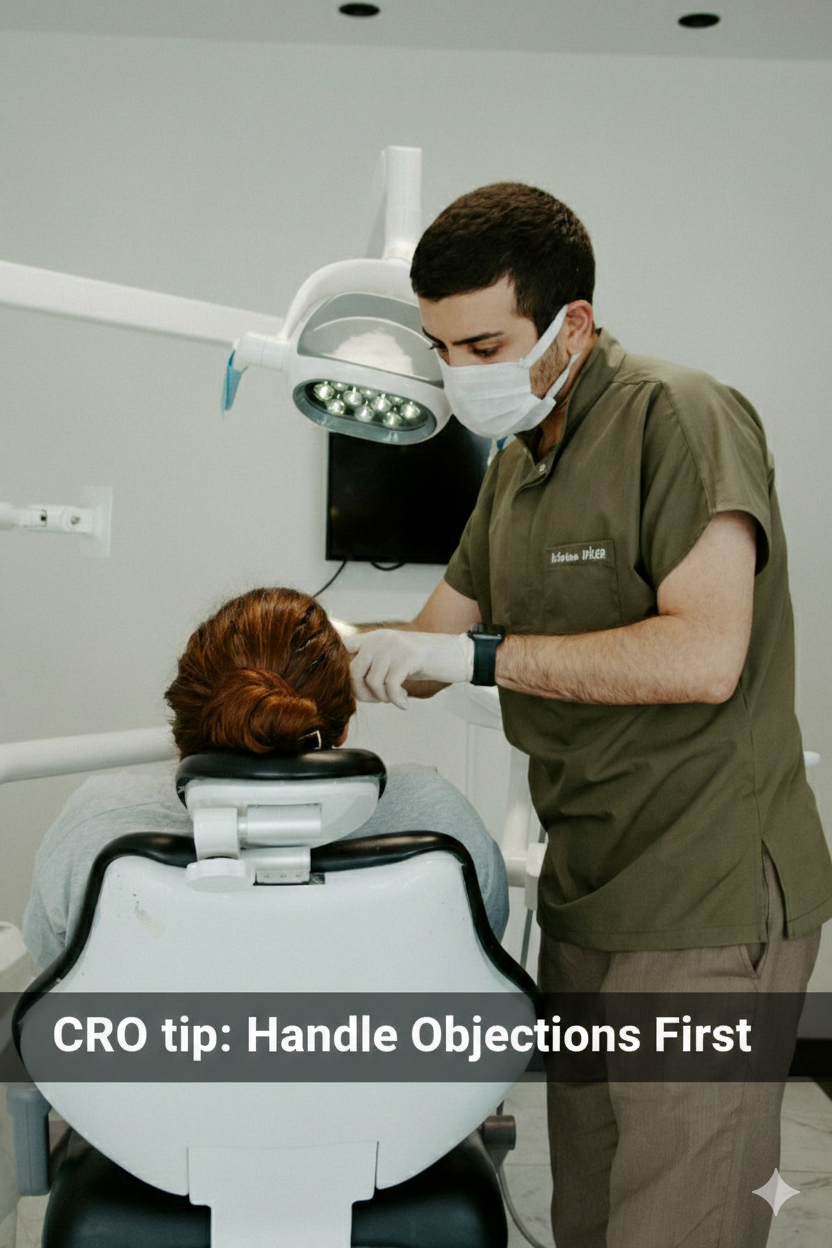
Assuming a well-matched patient has arrived on the page and is genuinely interested, the offer itself has to close the gap between that interest and a concrete action. A surprising number of specialist practice funnels fail at exactly this point, not because no offer exists, but because the offer is positioned incorrectly, the urgency behind it is buried rather than felt, and the first step asks for a level of commitment the patient has not yet been given a reason to make.
A free consultation offer anchored to a time-limited price point carries real conversion potential, but only under specific conditions when they are all met. The scarcity and urgency need to be visible and credible rather than mentioned once in a paragraph the patient may never reach. The value of that consultation needs to be established through proof, patient outcomes, and process clarity before the ask is made, not presented above the fold before the patient has encountered any reason to trust the practice. On mobile in particular, a phone number or call to action appearing before social proof, before results, and before any demonstration of clinical authority asks a patient to commit before they have been given the foundation to do so. The page architecture has to earn the action before it requests it.
A structured diagnostic at this lens examines whether the offer is sequenced where it can actually convert, whether urgency is communicated with enough clarity to create genuine forward momentum, and whether the first step feels specific and low-risk rather than premature and transactionally cold.
Lens 3: Page Structure, Messaging, and Trust Architecture
Once a patient has arrived and understood what is being offered, the page has to do the harder work of earning a decision from someone who is simultaneously evaluating multiple providers, managing uncertainty about cost and outcomes, and looking for signals that this particular practice understands their specific situation.
Authority in a specialist context is not built through a credentials list or a paragraph about years of experience. Patients arriving at an orthodontic website or a physiotherapist practice or a hair clinic already assume the practice is qualified. What they are actually evaluating is whether the practice has encountered their specific problem before, whether the results shown reflect outcomes they could realistically expect, and whether the copy speaks to the experience of being in their position rather than describing the service from the provider's perspective. I´ve recently dealt with this from a patient´s perspective. I wanted a hair clinic where I could get a hair scan with 3D and was ready to pay for it. However, the consequence was a treatment plan, including medication and procedures. I definitely needed to research and see proof or directional evidence that this could solve my problem. I am not saying that it will, but ¨could¨, enough proof and trust which handles by objections before paying 1500 for a series of treatments.
Hero sections framed around the practice rather than the patient's concern are one of the most consistent conversion suppressors in specialist healthcare websites. When social proof, before-and-after results, process explanation, and objection handling appear after the conversion ask rather than before it, the page is structured around what is convenient for the practice rather than what the patient needs in order to feel ready to commit. Simple right? I cannot count on my hands how many times I saw it wrong and the reason is that your developer or web agency wouldn´t care. You wanted a website and they did it, they didn´t think about your conversion architecture. Competing calls to action at different points on the page fragment attention and dilute the primary conversion path, a problem that becomes more acute on mobile where layout constraints make every sequencing decision more consequential.
A structured diagnostic at this lens examines whether the messaging speaks directly to the patient's concern or describes the practice in terms that could apply to any competitor, whether the trust architecture is sequenced in the order a patient actually needs it, and whether the objections that most commonly prevent orthodontic patients from committing, around cost, timeline, suitability, and risk, are addressed before the patient is asked to act.
Lens 4: Data Infrastructure and Post-Click Intelligence

Google Analytics 4 tells a practice what happened in aggregate but does not explain why qualified visitors lost momentum before converting. Session recordings and heatmap tools like Microsoft Clarity, which is free and deployable through Google Tag Manager alongside GA4, show the full behavioural picture: where patients scroll before leaving, which elements attract interaction, where hesitation appears in a form, and which sections of a page are being skipped entirely by the visitors most likely to convert. That layer of qualitative data is what turns a list of hypotheses about conversion problems into a ranked set of evidence-backed priorities.
For practices running Google Ads to location-specific pages, the same lens examines whether those pages are built to convert the intent generated by those campaigns or whether paid traffic is landing on experiences designed for a different type of visitor entirely. A Meta ad funnel for a free consultation offer creates a specific visitor psychology that requires a specific post-click experience. When the landing page starts the trust-building process from zero rather than continuing the conversation the ad began, conversion rates reflect the disconnect.
A structured diagnostic at this lens examines what behavioural data currently exists, what it reveals about where qualified patients are losing momentum, and whether the tracking infrastructure is sufficient to support ongoing optimisation decisions rather than one-off changes made without the means to measure their impact.
Why All Four Lenses Have to Be Examined Together
A single-point fix rarely resolves a specialist practice conversion problem because these four areas are interdependent in ways that make isolated changes insufficient. Restructuring the page hierarchy produces limited results if paid traffic is arriving in the wrong intent state for the experience being delivered. Sharpening the offer fails to move numbers if the trust architecture around it is too thin for a patient to feel ready to act on it. Strong messaging and a clearly defined first step produce unreliable outcomes when there is no behavioural data to validate whether the changes are working or to identify where the next point of friction has emerged.
Funnel leakage in specialist practices is cumulative rather than catastrophic. Each point of friction reduces the percentage of patients moving forward, and because those losses are distributed across multiple stages rather than concentrated at one obvious point, they are easy to overlook when the primary measurement is traffic volume or lead count rather than consultation booking rate.
The question that drives a useful diagnostic is not where patients are dropping off in the abstract. It is which of the four lenses is producing the most friction in a specific funnel, given the current traffic mix, the current offer structure, and the current page architecture, and where fixing that friction will produce the highest return on the effort invested.
What a Structured Conversion Engagement Produces
When traffic intent, offer architecture, page structure, and behavioral data are examined together professionally as an integrated system rather than as separate workstreams managed by different people with different goals, the output is a prioritised action plan tied to where real decision friction exists rather than a comprehensive list of improvements with no hierarchy of importance.
For a specialist health practice of any kind that typically means restructuring the page sequence so that trust is established before the conversion ask, making offer urgency visible rather than incidental, consolidating competing calls to action into a single primary path, and ensuring that paid traffic lands on experiences built for the intent those campaigns are generating rather than generic pages that ask a high-consideration patient to start their evaluation from scratch.
The deliverable is not a redesigned website. It is a patient journey that converts qualified visitors into consultation requests at a measurably higher rate, supported by the data infrastructure to prove what is working and to continue improving what is not.
Frequently Asked Questions
Why is my specialist healthcare website getting traffic but not converting into consultation requests?
The most common cause is a mismatch between the intent of the visitors arriving on the page and the experience the page delivers. Patients who arrive from different sources, paid search, Meta ads, organic results — carry different levels of readiness to commit, and a page that treats all of them identically will underperform across all of them. Beyond intent mismatch, the most frequent structural causes are a conversion ask that appears before the page has established enough trust to support it, an offer whose value and urgency are not communicated clearly enough to motivate action, and competing calls to action that dilute the primary conversion path rather than reinforcing it.
What is conversion rate optimization for healthcare, and how is it different from general CRO?
Conversion rate optimization for specialist healthcare practices applies the same principles as general CRO — behavioural data analysis, page structure testing, messaging refinement, friction removal BUT within the specific psychology of a high-consideration medical decision. Someone who runs ecommerce funnels day in and out may not get your xxxx $ offering. Patients choosing a specialist are not making the same kind of decision as someone purchasing a product online. They are managing real uncertainty about clinical outcomes, financial commitment, and whether a particular provider is the right fit for their specific situation. Healthcare CRO has to account for that decision psychology at every stage of the funnel, from the intent signals in the traffic arriving at the page to the trust architecture that earns the final commitment to book.
How do I know if my Google Ads are sending the wrong patients to my landing page?
The clearest indicator is a meaningful gap between click-through rate and consultation booking rate. If campaigns are generating consistent clicks but those clicks are not converting into enquiries, the most likely explanations are keyword intent mismatch, where the search terms triggering ads attract patients who are browsing rather than deciding, or a post-click experience that does not continue the conversation the ad began. Running separate campaigns to location-specific pages compounds the problem if those pages are not built around the specific intent of the traffic each campaign generates. Behavioral data from session recordings layered alongside GA4 conversion tracking is usually what makes the source of the disconnect visible.
What data tools should a specialist practice use to diagnose funnel problems?
The most effective setup for a specialist practice combines GA4 for aggregate conversion tracking, Microsoft Clarity for free session recordings and heatmaps, and Google Tag Manager to deploy both without ongoing developer dependency. Together these tools show not just what is happening in the funnel at a statistical level but why it is happening at a behavioural level, specifically where patients are losing momentum, which page sections they are engaging with, and where the decision to leave rather than book is being made. Without that layer of qualitative behavioural data, optimisation decisions are made on hypothesis rather than evidence, and the changes that get prioritised are often not the ones that would have moved the conversion rate most. My diagnostics also includes tracking review, because you cannot improve what you don´t measure, so you may not have the right tracking in place just yet.
Why does page section order matter so much for healthcare conversion?
Because patients making high-consideration decisions follow a specific psychological sequence before they are ready to commit. They need to confirm they are in the right place, understand what the experience will actually look like for someone in their situation, encounter proof that the practice has produced outcomes for patients like them, have their most likely objections addressed, and only then feel ready to act on an offer. A page that presents the conversion ask before completing that sequence is asking patients to make a decision they are not yet equipped to make. The practical consequence on mobile, where most specialist practice traffic now arrives, is that a phone number or booking button appearing above social proof, clinical results, and trust signals encounters patients who have not yet been given a reason to act, and most of them will scroll past it or leave rather than commit.
What is the difference between a lead and a qualified consultation request for a specialist practice?
A lead is any contact submission or enquiry, regardless of the quality of the patient behind it. A qualified consultation request comes from a patient whose situation is a genuine fit for the practice's services, who has enough understanding of the offer and the process to attend and engage meaningfully with a consultation, and who has the intent and financial capacity to move forward if the consultation confirms fit. The distinction matters because optimising for lead volume without regard for lead quality produces a high volume of enquiries that do not convert into patients, inflates acquisition cost, and consumes clinical time without producing revenue. A well-structured funnel qualifies intent through page messaging and offer framing before the enquiry is submitted, so the consultations that are booked are with patients who are genuinely ready to consider treatment.
How long does it take to see conversion improvements after a funnel diagnostic?
The timeline depends on which of the four diagnostic lenses reveals the highest-friction problems and how complex the changes required to address them are. Offer repositioning, CTA consolidation, and page section resequencing are changes that can be implemented and measured within weeks and often produce visible movement in consultation booking rate quickly. Deeper changes to messaging architecture, paid campaign structure, or tracking infrastructure take longer to implement and require more time to accumulate statistically meaningful data. The value of a prioritised diagnostic is that it identifies which changes will produce the most impact first, so effort is concentrated where return is highest rather than distributed evenly across every possible improvement.
Related posts:
How to Audit a Broker Conversion Page That Isn't Converting
You've confirmed the traffic is right and the journey works. This is how you find out what the page is actually missing.
How to Check Whether Your Traffic Is Actually Worth Converting
The session count is the least useful number in your report. Here's what to look at instead.
The 4-Pillar Funnel Review for Insurance and Finance Brokers Running Paid Search
Most brokers redesign the page before they know which stage is broken. This is how you find it first.