Conversion architecture for your SaaS marketing funnel
SAAS marketing funnel debunked
After auditing 50+ B2B and B2C SaaS marketing funnels, I've seen a repeated mistake: teams pour budget into acquisition while their funnel leaks revenue at every stage transition.
The symptoms are predictable. Declining ad performance. Five-second site sessions in any user behavior tracking software. Demo requests from unqualified prospects. Trials that never convert. The fix is always the same: spend more on ads. It´s just the easiest bandage you can get.
But here's what most SaaS marketing teams miss, paid traffic doesn't create demand. It amplifies whatever conversion infrastructure already exists. If your funnel leaks, ads simply accelerate the bleeding and you just spend more and more on ads with no conversions.
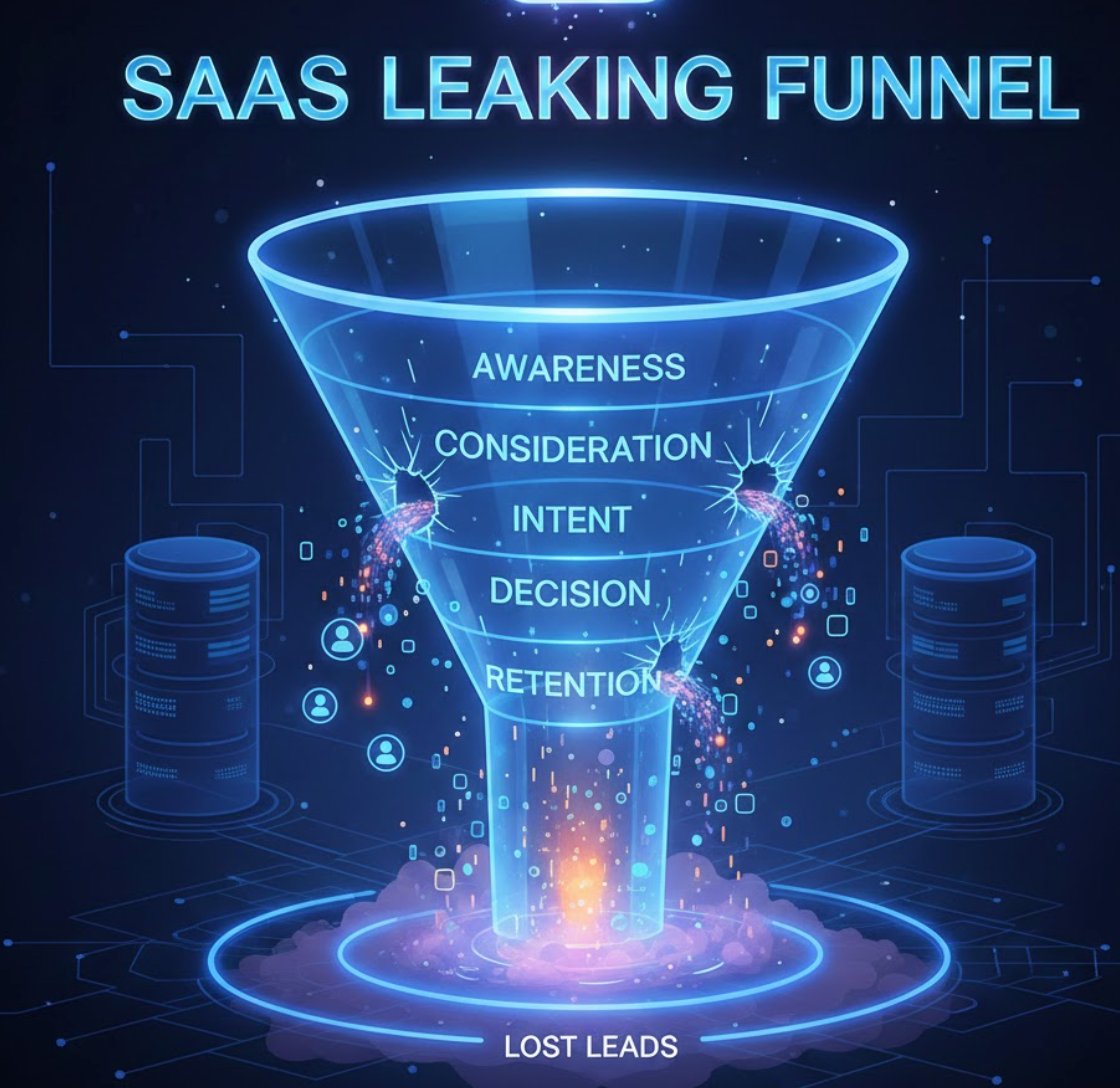
The issue isn't traffic volume. It's that your B2B SaaS marketing funnel breaks at the handoffs.
Why Traditional Funnel Funnel Does Not Fit SAAS
Most teams measure performance in silos. Ads are optimized for CTR. Websites are judged on bounce rate. Product focuses on activation. Sales tracks demo-to-close rates.
But revenue is lost in the transitions between these stages.
There are two critical handoffs where SaaS funnels quietly fail:
Click → Website experience: When the ad promise doesn't match the landing page message, users reset their expectations and leave.
Website → Product experience: When the value proposition on your site doesn't connect to the actual product workflow, activation is a dream and adoption stalls.
High-performing SaaS companies don't just track clicks and conversions. They engineer message continuity and intent alignment across every funnel stage, including website and product optimization.
Think of your SaaS marketing funnel as a psychological system, not a linear path. Growth stalls when your messaging doesn't match where the buyer is mentally. Category leaders optimize for movement velocity and retention, not just traffic volume.
The Six-Stage SaaS Marketing Funnel Framework
Here's the full-funnel blueprint that separates scaling SaaS companies from stagnant ones.
Phase 1: The Acquisition Engine (Top of Funnel aka TOFU)
Stage 1: Awareness – Solving the "95% Problem"
At any given moment, 95% of your total addressable market isn't buying. They feel friction but haven't named the problem yet.
The Goal: Move prospects from "Who are you?" to "You understand my problem."
What: Original research, problem-centric content, clear point of view. Notion built awareness by talking about workspace chaos before pitching their product. Gong created a category by naming "revenue intelligence" before most teams knew it existed.
Failure: Product-first messaging BEFORE problem awareness. When you lead with features while prospects are still figuring out if they have a problem, they bounce immediately.
B2B Example: HubSpot didn't start by selling CRM software. They published the concept of "inbound marketing" and built awareness around a methodology before positioning their tool.
B2C SaaS Example: Calm didn't lead with app features. They built awareness around the anxiety epidemic and positioned meditation as the solution category.
Stage 2: Consideration – Selling the Method Before the Tool
Buyers at this stage aren't choosing vendors yet. They're choosing approaches to solve their problem.
Goal: Establish your methodology as the default framework.
What: Educational frameworks, ROI calculators, deep-dive content that builds authority. Drift created "Conversational Marketing" as a category. Amplitude evangelized "Product Analytics" as a discipline and they continue building tools around the product culture.
Failure: Generic nurture sequences that gate all value behind a demo request. If your emails don't provide insight without requiring a login, they're ignored.
B2B Example: Datadog built consideration by teaching modern infrastructure monitoring practices, positioning their approach as the standard before prospects evaluated specific tools.
B2C Example: Duolingo created content around language learning science and gamification psychology, establishing their method before asking users to choose an app.
Phase 2: The Conversion Bridge (Middle of Funnel)
Stage 3: Evaluation – Friction Is Your Real Competitor
This is the shortlist stage. Buying committees are involved, and they're actively looking for reasons to disqualify you.
Goal: Become the easiest option to understand and evaluate. When I say easiest, I want you to think about the friction to resolve here.
What: Self-serve product tours, interactive demos, transparent pricing logic, comprehensive documentation. Loom lets you experience the product in seconds. Figma's freemium model removed all evaluation friction and they introduce new features in smart modals.
Failure: Gated demos that require 48-hour wait times. What I see and it´s worse is that the user doesn´t even understand they would need 48 h wait time. Unclear pricing that forces prospects into sales conversations. If a prospect has to wait to see value, you've already lost to the competitor with instant access.
B2B Example: Stripe provided detailed API documentation and sandbox environments, letting developers evaluate the product without ever talking to sales. Do you know a developer who wants to talk to sales ;)
B2C SaaS Example: Canva's freemium model with instant access removed all evaluation barriers, letting users experience value before any commitment.
Stage 4: Decision – No more Trust Gap

The Goal: De-risk the decision completely.
What : Action plans that outline the path to value. Social proof from similar companies. Security certifications. Cost-of-inaction narratives that make status quo more expensive than change.
What Fails: Leaving buyers to justify the purchase internally without ammunition. Generic case studies that don't match their industry or use case.
Reality Check: "No decision" is the most common and most expensive outcome in B2B SaaS. It's not that prospects chose a competitor. They chose to do nothing, because you didn't make the decision feel safe enough.
B2B Example: Salesforce provides industry-specific ROI calculators and executive business cases that help champions sell internally.
Phase 3: The Retention Loop (Bottom of Funnel & Beyond)
Stage 5: Activation – Time-to-Value Is Everything
The contract is signed, but the relationship hasn't started until users experience value. In SaaS marketing funnels, activation is where the real growth multiplier lives. And guess what, activation is often times the hardest one to optimize and the one where you win or lose.
The Goal: Get users to their "Aha!" moment as fast as possible.
What: Guided onboarding flows with clear progress indicators. Quick wins in the first session. Champion enablement that helps power users succeed immediately. Airtable provides templates that show value before you build anything custom. I want to repeat it again, but forget about the empty state as it just turns your users away.
Failure: Blank product states with no guidance. Long setup cycles that delay value realization. If your time-to-value exceeds 7 days in B2C or 30 days in B2B, churn is already programmed.
B2B Example: Mixpanel reduced time-to-first-insight from weeks to hours by providing pre-built dashboards and sample data.
B2C SaaS Example: Grammarly shows value in the first sentence you write, creating instant activation.
Stage 6: Expansion + Advocacy – The NRR Engine
The Goal: Evolve from vendor to strategic partner and increase your CLTV.
What: Executive Business Reviews focused on outcomes, not features. Community programs that create belonging. Clear expansion paths tied to customer success milestones.
Failire: Reactive account management that only engages 30 days before renewal. Happy customers don't just renew—they expand, refer, and become your most efficient marketing channel.
Where SaaS Marketing Funnels Actually Break
Different go-to-market motions create different failure patterns. Here's where sales-led and product-led funnels leak most.
Sales-Led SaaS: The Qualification Problem
High demo volume often masks low intent. Here's what goes wrong in traditional B2B SaaS marketing funnels:
- Demo CTAs appear before prospects have problem clarity
- Messaging attracts curiosity, not qualified buyers
- Weak ICP filtering lets anyone book time
- Sales inherits unqualified leads and wastes time on tire-kickers
The result: Busy calendars, low close rates, and inflated customer acquisition costs.
Example: A marketing automation platform was booking 100+ demos monthly but closing under 5%. The issue wasn't sales execution, but their landing pages attracted solopreneurs who couldn't afford enterprise pricing. We redesigned their funnel to qualify based on team size and budget before offering demos. Demo volume dropped 60%, but close rates jumped to 18%.
Product-Led Growth: The Activation Problem
Removing friction doesn't guarantee adoption. Self-serve SaaS funnels fail when:
- Users hit blank product states with no guidance
- The "Aha!" moment isn't obvious or immediate or buried beyond the first 3 clicks
- Setup effort exceeds perceived value and users vanish before you can get a second chance
- There's no contextual education during first use
Result: High signup rates but abysmal trial-to-paid conversion.
Example: A project management tool had 10,000 monthly signups but 2% activation. Users would create an account, see an empty board, and leave. They rebuilt onboarding with sample projects and guided first tasks. Activation jumped to 23% without changing the product.
The Components That Make SaaS Marketing Funnels Convert
High-performing funnels are built around intent-matching components at each stage.
For Sales-Led B2B SaaS:
- Problem-first landing pages that reflect buyer language, not product jargon
- Qualification before conversion through strategic form fields or interactive tools
- Clear "who this is for / not for" messaging that repels bad fits
- Pre-demo trust building with customer proof, security badges, and risk reducers
- Sales enablement that continues the marketing narrative into conversations
For Product-Led SaaS:
- Clear promise before signup that sets accurate expectations
- Guided first session that leads users to value, not just features
- Visible progress indicators that show advancement toward outcomes
- Contextual education triggered by real user behavior and clear product aha moment mapping to features.
- Expansion paths that only appear after initial success
The principle is identical: reduce cognitive load while increasing confidence at every stage.
Find the Biggest Leak
Don't try to fix everything at once. Run a stage movement analysis and identify where the largest percentage of prospects drop.
If the leak is Traffic → Lead: Your value proposition isn't resonating. Prospects don't see themselves in your messaging or don't believe you solve their problem.
If the leak is Lead → Qualified Opportunity: You're attracting the wrong audience or haven't built enough trust. Your targeting or messaging needs refinement.
If the leak is Trial → Paid: Your activation is broken. Users aren't experiencing value quickly enough to justify payment.
If the leak is Demo → Close: Sales enablement is weak, or you're not de-risking the decision. Buyers don't feel confident enough to commit.
Fix the largest leak first. Everything else compounds from there.
Real-World Funnel Optimization Results
B2C SaaS Case – Productivity App: Their leak was at activation. 40% of signups never completed setup. We simplified onboarding to 3 steps and added template libraries to break the empty state. Trial-to-paid conversion jumped from 8% to 19% in 60 days.
The Myth of "Just Add More Traffic"
The biggest growth myth in SaaS is that acquisition is the hard part. It isn't.
Growth is engineered after the click, after the trial starts, and after the sale closes. Until your B2B SaaS marketing funnel is designed to move buyers through psychological transitions not just attract them, you're not building a scalable growth engine.
You're filling a bucket with holes.
Category leaders understand this. They know that a full-funnel SaaS marketing approach means optimizing message continuity across every stage, matching content to buyer intent, and removing friction at every transition point.
What a True Full-Funnel SaaS Marketing Agency Delivers
If you're partnering with an agency to build your SaaS marketing funnel, "leads" are a vanity metric. A real growth partner focuses on pipeline contribution and revenue movement.
What "good" looks like:

- Strategy: 90-day roadmap focused on fixing specific funnel leaks, not generic "brand awareness"
- CRO: Continuous testing of high-intent pages with dedicated design and development resources
- Enablement: Arming sales with battle cards, ROI tools, and talk tracks that continue the marketing narrative
- Analytics: Multi-touch attribution, cohort analysis, and growth tracking not just clicks and impressions
Red flags to avoid:
- Agencies that jump straight to "running ads" without diagnosing funnel health
- Partners with no post-purchase or activation expertise
- Teams that report on traffic and MQLs without connecting to revenue
- Vendors who treat your funnel as a series of isolated tactics instead of a connected system. Often times they don´t have expertise in all of these.
3 Questions to Ask Before You Hire
- "How do you calculate the cost of inaction for our prospects?" Tests their messaging depth and ability to drive urgency.
- "What's your framework for reducing time-to-value?" Tests whether they understand post-purchase growth dynamics and whether they try to understand your product aha moments.
- "Can you tell us what to expect in the first month?" Yes, growth compounds over time, but a good team should ask about your users, data and roll up their sleeves to give you a plan in the first month plus low hanging fruit opportunities to focus on.
Where to Start: The Funnel Leakage Audit
Most SaaS companies are sitting on a backlog of near-miss revenue—prospects who clicked, explored, and almost converted before falling through the cracks.
The fastest way to unlock growth isn't adding more traffic. It's finding where your funnel leaks and plugging it systematically.
A proper funnel leakage audit maps:
- Click → website → product handoffs and where message continuity breaks
- Intent mismatches across each stage of your SaaS marketing funnel
- Qualification and activation gaps that inflate CAC and reduce LTV
- The single biggest drop-off limiting revenue today
We don't deliver "ideas" or generic recommendations. We deliver prioritized actions tied to measurable revenue movement, the roadmap that turns your SaaS marketing funnel from a leaky bucket into a growth engine.
If you want to stop losing and start fixing the real constraints in your funnel end to end, this is where it begins.
Ready to identify your biggest funnel leak? Let's map where revenue is slipping through the cracks and build the roadmap to fix it.
GrowthLens Labs would be happy to be your growth partner, we care about real outcomes vs. deliverables, let´s fix your activation. Want a quick fix audit? Shoot your website URL on Growthlens.io and I will run a free 5-point audit for you or book your detailed growth audit to turn visitors into customers. If you are looking for a funnel audit, you can book a meeting with me.
Related posts:
How to Audit a Broker Conversion Page That Isn't Converting
You've confirmed the traffic is right and the journey works. This is how you find out what the page is actually missing.
How to Check Whether Your Traffic Is Actually Worth Converting
The session count is the least useful number in your report. Here's what to look at instead.
Your Traffic Looks Fine. So Why Aren't People Enquiring?
When the acquisition is right but the page doesn't match what the visitor came for, you have an intent problem. Here's how to diagnose it.