The Core Principle: Match the Page to the Traffic's Awareness Level
Why the gap between your ad promise and your landing page is costing you cold traffic conversions — and what four structural fixes actually change.
Every landing page is, in essence, an answer to questions the visitor brings with them.
The mistake most businesses make is building a page that answers warm traffic's questions — then calling it a high-converting landing page because it converts at 4% for their email list. When they run cold ads and see 1.2%, they conclude paid advertising doesn't work for their business. The page was never the variable they thought they were testing.
Cold traffic needs a page that:
- Names the pain before naming the solution
- Shows the product before explaining the transformation
- Removes barriers — time, cost, commitment — proactively, before the visitor has to raise them
- Uses specific, verifiable social proof rather than assertions of trust
- Maintains CTA consistency throughout, so every decision point feels like the same confident invitation
- Aligns with the ad intent and the ad traffic source
Warm traffic needs a page that:
- Reinforces the aspiration they've already formed
- Confirms the brand is aligned with what they've heard or been told
- Makes the path to starting as frictionless as possible
These aren't dramatically different pages, but the sections, layout and conversion psychology are different. In many cases, it's the same page with three or four targeted adjustments — the hero changes, the social proof section gets more specific, the CTA copy becomes more literal, the image gets reframed.
How to Audit Your Own Landing Page DIY for Paid Traffic
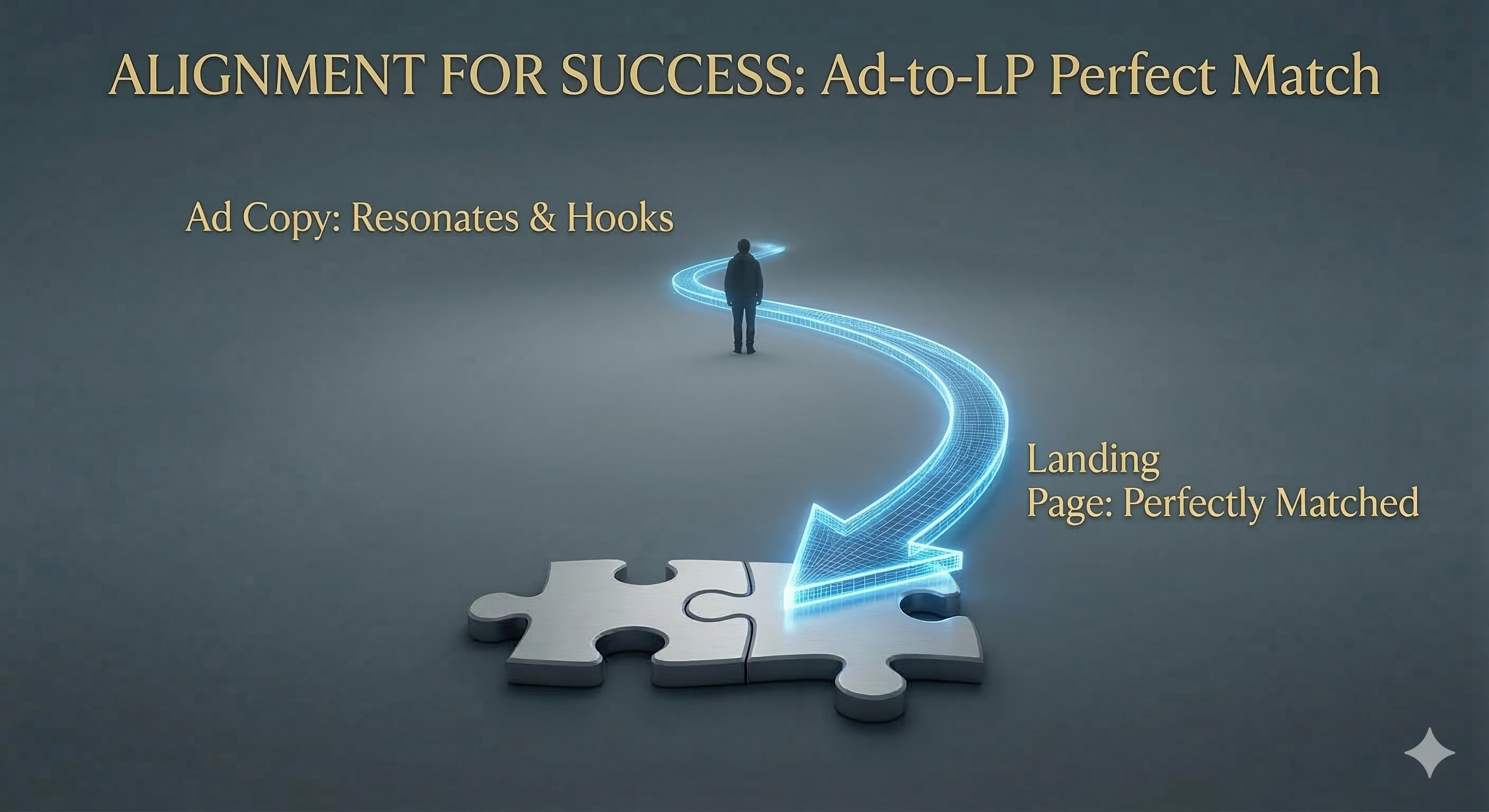
*0. Ad intent - Does this page match the intent of the ad which you sent traffic from Cold traffic needs to see themselves in the problem before they can believe in the fix. If your hero leads with what you offer rather than what they're experiencing, you're losing people before they reach the second line.
1. Does your hero copy name the pain, or the solution? Cold traffic needs to see themselves in the problem before they can believe in the fix. If your hero leads with what you offer rather than what they're experiencing, you're losing people before they reach the second line.
2. Does your hero image reflect the product, or just the aspiration? If someone looked only at your hero image for three seconds, would they know what they'd be clicking into? Ambiguity at the image level costs you visitors before the copy gets a chance.
3. Are your CTAs sending the same message every time they appear? Count the CTA variations across your page. More than one is usually one too many for cold traffic.
4. Can your social proof be believed by a stranger? Replace every instance of "countless," "many," or "trusted by" with the most specific honest claim you can make. This single change consistently improves cold traffic conversion — because specificity signals verifiability, and verifiability is what trust is actually built on.
rue alignment operates at four levels, each building on the last:
1. Message continuity The specific claim, offer, or promise made in the ad is reflected immediately on the landing page — in the hero headline, the subheading, or the first sentence of body copy. Not somewhere on the page. Above the fold, before the visitor has to make any effort.
2. Intent continuity The page addresses the same stage of awareness the ad spoke to. An ad targeting a problem-aware audience ("struggling to get clients from your website?") that lands on a page built for solution-aware visitors ("our CRO service increases conversions by 40%") has a continuity gap — even if the messaging is technically consistent.
3. Offer continuity If the ad promotes a specific offer — a free audit, a trial, a discount — that offer is the hero of the landing page. Not buried in a subheading. Not reframed as a secondary CTA. The offer the ad sold is the first thing the visitor sees and the primary action the page asks for.
4. Visual and tonal continuity The visual language of the landing page matches the register of the ad. A formal, data-led ad that lands on an informal, lifestyle-led page creates cognitive dissonance that cold visitors interpret as a mismatch — and mismatch signals risk.
Most alignment problems sit at levels 1 or 3. The ad makes a specific claim or promotes a specific offer, and the landing page delivers a generic brand experience instead.
How Misalignment Damages Your Google Ads Quality Score
Quality Score is Google's 1–10 rating of how relevant and useful your ad is to the person searching. It's calculated per keyword and directly determines two things most advertisers care about deeply: your cost-per-click and your ad rank.
Landing page experience is where alignment failures show up in the Quality Score calculation — and it carries significant weight.
Google assesses landing page experience based on several signals:
- Relevance — does the page content match the keyword and ad copy?
- Transparency — is it clear what the page is, who runs it, and what the visitor is being asked to do?
- Navigation ease — can visitors find what they came for without friction?
- Bounce signals — do visitors leave immediately after arriving?
When your landing page doesn't match what your ad implied, Google registers the mismatch through behavioural signals — high bounce rates, low time on page, low conversion rates — and assigns a below-average landing page experience score.
What a below-average landing page experience score costs you:
- Your Quality Score drops — often from 6-7 to 3-4 range
- Your cost-per-click increases — because a lower Quality Score means you pay more to maintain the same ad position
- Your ad rank falls — meaning competitors with better alignment outrank you even on lower bids
- Your campaign efficiency compounds negatively over time — more spend for fewer impressions, fewer impressions for fewer clicks, fewer clicks for fewer conversions
The arithmetic is straightforward: a Quality Score of 7 versus a Quality Score of 4 on the same keyword can represent a 30-50% difference in cost-per-click. On any meaningful ad spend, that gap is the difference between a campaign that's profitable and one that perpetually underperforms.
The Specific Alignment Signals Google Checks
Understanding what Google actually evaluates on your landing page helps make the fix precise rather than speculative.
Keyword presence in page content Google checks whether the search terms that triggered the ad appear naturally in the landing page — in the title, in the headline, in the body copy. Not keyword stuffing. Contextual, relevant presence that confirms the page is about what the visitor searched for.
Page load speed A slow landing page is penalised directly in the landing page experience score. Google's PageSpeed data informs the Quality Score calculation. A page that takes four seconds to load on mobile is losing Quality Score points before a visitor reads a single word.
Mobile experience The majority of Google Ads clicks on most verticals now happen on mobile. A landing page that isn't optimised for mobile — truncated headlines, poorly scaled images, tiny CTA buttons — registers as a poor experience regardless of how well the desktop version performs.
Bounce rate signals When visitors arrive and leave immediately, Google infers that the page didn't satisfy the intent behind the click. This is the behavioural consequence of misalignment — and it feeds directly back into the Quality Score calculation.
Destination relevance Google checks whether the landing page destination is the most relevant page for the ad — not your homepage, not a generic services page, but a page built specifically to address the intent of that keyword and ad group. Generic destinations are a consistent source of below-average landing page experience scores.
How Meta Measures Post-Click Experience
Meta operates differently to Google but the underlying principle is the same: the platform rewards advertisers whose post-click experience matches what the ad implied, and penalises those whose doesn't.
Meta doesn't publish a Quality Score equivalent, but it uses several metrics that function similarly:
Relevance Score (now broken into three diagnostic metrics) Meta replaced its single Relevance Score with three separate measures:
- Quality ranking — how the ad quality compares to ads competing for the same audience
- Engagement rate ranking — how the expected engagement rate compares to ads competing for the same audience
- Conversion rate ranking — how the expected conversion rate compares to ads with the same optimisation goal and audience
Conversion rate ranking is where landing page alignment shows up most directly. Meta's algorithm estimates the probability that a click will result in the conversion event you're optimising for. If your historical post-click conversion rate is low relative to competitors targeting the same audience, your conversion rate ranking falls — and your cost-per-result rises.
The feedback loop Meta runs Meta tracks what happens after the click through its pixel. If visitors consistently arrive, don't convert, and return to Facebook or Instagram quickly, Meta interprets this as a signal that the ad overpromised relative to what the page delivered. Over time, this degrades campaign performance and increases CPMs — the cost per thousand impressions — which raises the effective cost of every click.
Landing page views vs link clicks Meta distinguishes between link clicks (someone clicked the ad) and landing page views (someone clicked and the page actually loaded before they left). A large gap between these two numbers — more than 15-20% — typically indicates either a page speed problem or a creative-to-page expectation mismatch that causes visitors to exit before the page loads.
This gap is one of the clearest diagnostic signals of alignment failure at the ad level.
A Real Pattern from a Recent Client
A recent client in the professional services space was running Meta ads targeting a specific pain point around compliance documentation. The ad creative was direct, problem-led, and well-targeted. Click-through rates were strong.
The landing page was the company's services overview page. It covered three service lines, led with the company's founding story, and had a "get in touch" form at the bottom.
The conversion rate was 0.8%. The cost per lead was making the campaign economically unworkable.
The structural gap was straightforward: the ad spoke to a specific, urgent pain. The landing page answered a different, broader question. The visitor who clicked expecting a direct solution to their compliance problem arrived at a page that asked them to first understand the company's full service offering before getting to the thing they came for.
Four changes were made:
- A dedicated landing page built to match the specific ad claim — same language, same problem framing, same offer in the hero
- The compliance pain point named explicitly in the H1
- Social proof specific to compliance clients placed in the hero section, not in a testimonials block lower down
- A single CTA — consistent throughout — replacing the multiple navigation options that were pulling visitors off the conversion path
Conversion rate moved to 3.1%. Cost per lead dropped by 61%. The ad spend didn't change. The targeting didn't change. The alignment did.
The Four-Point Alignment Audit
Before adjusting bids, expanding audiences, or rewriting ad copy, run these four checks against every active landing page receiving paid traffic.
1. Read your ad, then read your landing page hero headline. Would a first-time visitor immediately know they are in exactly the right place? If the headline could apply to any ad for any product in your category, it is not aligned to the specific ad that sent the visitor there.
2. Find the offer or claim your ad led with. Is it the first thing your landing page hero communicates — or does the visitor have to scroll or read past other content to find it? If they have to look for it, you have an offer continuity problem.
3. Check your keyword list against your landing page copy. Do the primary keywords that trigger your ads appear naturally in the landing page headline, subheading, and body copy? If not, Google is likely assigning a below-average relevance score to that page for those keywords.
4. Pull your Meta landing page views vs link clicks. Open Ads Manager, add the landing page views column, and compare it to link clicks. A gap larger than 15% is a direct signal of either a page speed problem or a creative-to-page expectation mismatch worth investigating.
What to Fix First
If this audit surfaces multiple issues, prioritise in this order:
First — message continuity in the hero. This is the highest-leverage fix because it affects both the visitor's decision to stay and the platform's assessment of landing page relevance. Rewrite the hero headline to directly mirror the ad's primary claim. This alone can shift Quality Score by 1-2 points on a keyword with meaningful search volume.
Second — offer placement. If the ad promoted a specific offer, that offer needs to be the primary visual and CTA of the landing page — not a secondary option that competes with other page goals.
Third — page speed. Run the page through Google's PageSpeed Insights. A score below 70 on mobile is costing you Quality Score points regardless of how well the messaging is aligned. This is a technical fix with a direct commercial impact.
Fourth — CTA consolidation. Count the number of distinct conversion paths on the page. Every additional option you give a cold traffic visitor is a decision that increases cognitive load and reduces the probability they take the primary action.
Where to Go From Here
If you've run this diagnostics and found one or more of these structural gaps, the path forward isn't a full redesign. It's targeted changes to specific elements, the hero headline, the CTA copy, the social proof section — informed by what your traffic data is already telling you.
This is the diagnostic work that makes paid advertising profitable rather than expensive.
If you'd like a second set of eyes on your landing page before your next campaign, I offer a free 20-minute review for service businesses and product founders running paid traffic. You'll leave with a clear picture of where your page is losing cold visitors and which changes will have the most impact.
If you're running paid traffic and your conversion rate or Quality Score isn't where it should be, a landing page alignment audit is usually the most direct route to fixing it.**
The GrowthLens diagnostic runs your post-click funnel through four lenses — including ad-to-page continuity — and identifies exactly where the structural gap is and what it's costing you in real terms.
Related posts:
The 4-Pillar Funnel Review for Insurance and Finance Brokers Running Paid Search
Most brokers redesign the page before they know which stage is broken. This is how you find it first.
Your Traffic Looks Fine. So Why Aren't People Enquiring?
When the acquisition is right but the page doesn't match what the visitor came for, you have an intent problem. Here's how to diagnose it.
How to Check Whether Your Traffic Is Actually Worth Converting
The session count is the least useful number in your report. Here's what to look at instead.